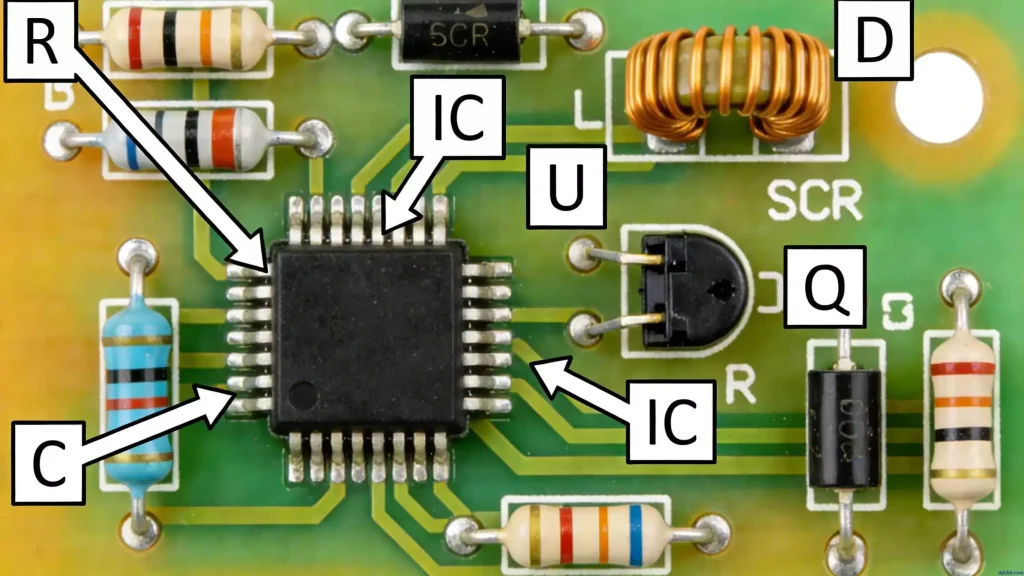
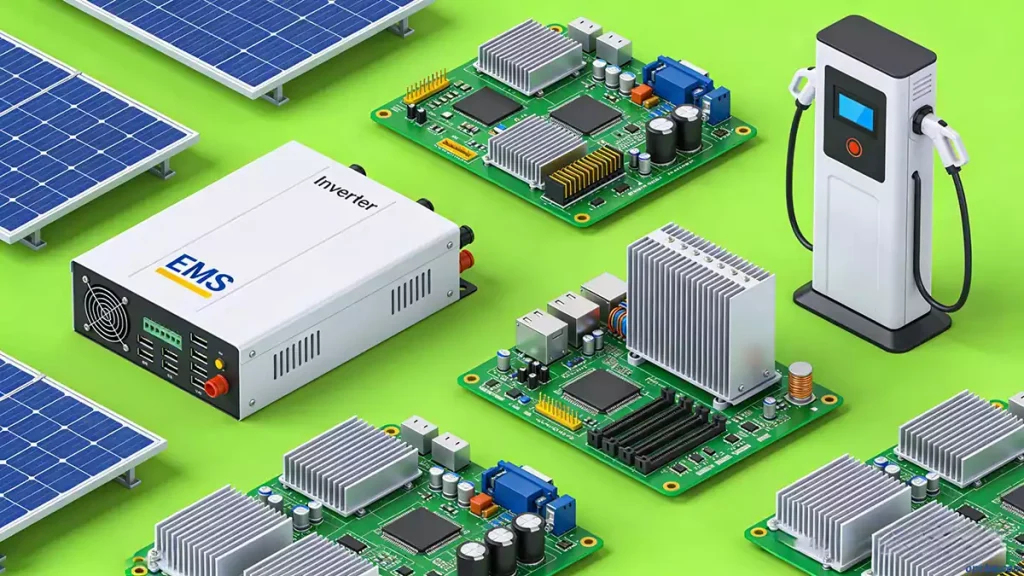
CCL PCB refers to printed circuit boards manufactured using copper clad laminate as the base material. In the electronics supply chain, CCL is the core raw material for all PCB production, also commonly called laminate or substrate.
copper clad laminate (CCL) is made by impregnating glass fiber cloth (or other reinforcement materials) with synthetic resin, coating one or both sides with copper foil, then curing under heat and pressure. For a deeper dive into what CCL is and its role in PCB manufacturing, explore our guide: What Is CCL? Copper Clad Laminate for PCB Manufacturing
In real manufacturing, CCL factories sit directly upstream of PCB fabrication facilities, with every PCB starting as a sheet of CCL.
Core Differences Between CCL and PCB
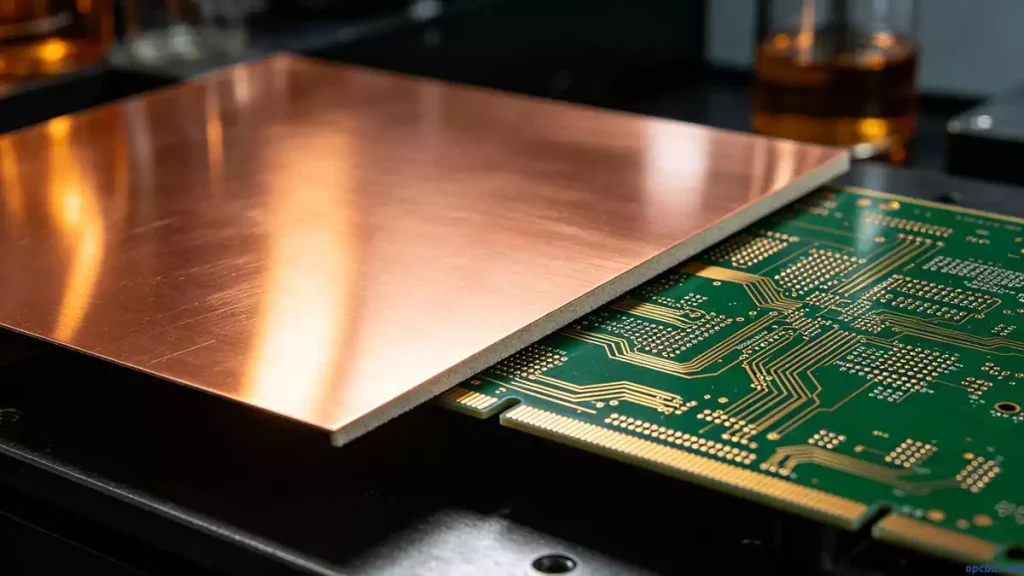
The simplest way to distinguish the two: CCL is the unfinished raw material, while PCB is the final functional circuit board.
CCL is a uniform sheet of resin, reinforcement material, and copper foil, with no etched circuits or functional features. It exists solely as the base for PCB fabrication.
A PCB is created by etching away unwanted copper foil from CCL to form conductive circuits, with additional processes like drilling, plating, and solder mask application to make it ready for component assembly.
For multilayer PCBs, the process builds on this base: inner layers are etched from individual CCL sheets, then laminated together with prepreg (adhesive sheets) under heat and pressure to form a single multilayer board.
Why CCL Quality Defines PCB Performance
As the foundation material for every PCB, CCL handles three core functions: circuit interconnection, electrical insulation, and structural support.
Its material properties directly impact signal transmission speed, energy loss, and characteristic impedance in the circuit. In practice, a PCB’s performance, manufacturability, production cost, and long-term reliability are all tied to the quality of its base CCL.
This is especially true for high-frequency, high-power, or automotive-grade PCBs, where even small variations in CCL dielectric properties can cause signal failure or reliability issues.
How CCL Becomes a Finished CCL PCB
Turning raw CCL into a functional CCL PCB is a multi-step process, with no single standard for every design, but follows a consistent core workflow.
First, the CCL is coated with photoresist, then exposed and developed to transfer the circuit design onto the copper foil. Unwanted copper is then etched away, leaving the desired conductive circuit pattern.
For double-sided and multilayer boards, the panel goes through drilling to create vias, followed by electroplating to form conductive connections between layers.
Final steps include solder mask application to protect circuits, surface finishing to prevent oxidation, and electrical testing to verify functionality. The entire process is far more complex than CCL manufacturing, with dozens of individual steps that vary by board design.
Simply put, CCL is the blank canvas, and PCB fabrication is the process of turning that canvas into a functional circuit board. Both use hot and cold pressing in production: CCL is created by pressing copper foil and prepreg together, while PCBs are made by pressing etched inner-layer CCL, additional prepreg, and copper foil into a finished panel.
If you need support with CCL PCB manufacturing, or have questions about CCL material selection for your design, OPCBA is here to help. Our technical team has decades of experience in PCB fabrication, and can help solve challenges across every stage of production. Reach out to us via email to learn more about our custom manufacturing services.