Where standard FR-4 runs out of room
Material upgrades usually get sold as better across the board, but 370HR solves a specific set of problems and mostly adds cost outside them. Working out where that boundary sits is the actual decision.
If you want the background first, start with what Isola 370HR is.This page assumes you know that much and focuses on whether your board needs it.
Standard FR-4 has a glass transition temperature around 130 to 140°C. That has carried decades of consumer electronics, and for a four-layer board that lives at room temperature it still works.
Margin disappears when several demands stack up. Lead-free reflow peaks near 260°C. On a 140°C laminate, the resin sits close to softening on every pass, and Z-axis expansion climbs with each cycle. Add high layer count, thick copper, or years of service at elevated temperature, and standard FR-4 stops being the safe answer.
The complete datasheet values live in a separate article. This page only uses the numbers that change the decision.
Four things that change
Figures below are typical values from Isola’s published 370HR datasheet. Confirm them against the current revision before you finalize a stack-up.
Temperature headroom comes first, and it is not the only one.
Thermal margin
Tg rises to 180°C and decomposition temperature to 340°C. A more useful way to read those numbers: a board on 370HR takes several lead-free reflow cycles without the resin system breaking down, which is what T260 and T288 measure.
Dimensional stability
Z-axis expansion from 50 to 260°C is 2.8%, against roughly 4 to 4.5% for standard FR-4. Plated through holes fail when the board expands further than the copper barrel can stretch. On a thick multilayer board that gap decides whether vias survive thermal cycling, and it carries more weight at the selection stage than most engineers expect.
CAF resistance
Conductive anodic filament growth is a slow failure. Copper migrates along the glass-resin interface under humidity and bias voltage, the board works, then fails months or years later. 370HR uses E-glass fabric chosen for CAF performance.
Process compatibility
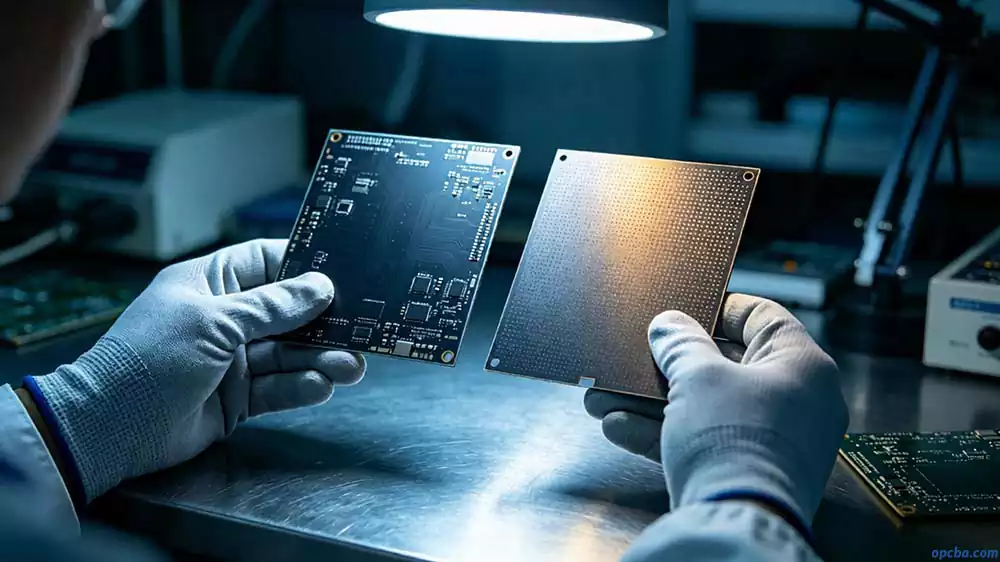
It runs close enough to standard FR-4 that fabricators do not need new equipment, which is why the cost step stays moderate instead of reaching polyimide or PTFE territory. If you want to see where this material sits in the wider picture, our overview covers how laminate systems are classified.
When it pays for itself
High layer counts and thick boards
Above roughly eight layers, or boards over 2.0 mm thick, Z-axis expansion becomes the dominant reliability risk. This is where 370HR earns its cost most clearly.
Sequential lamination
Boards built through multiple lamination cycles put earlier layers through repeated thermal stress. 370HR handles this better than many high-Tg alternatives, which is why it turns up in complex backplanes.
Automotive, industrial and medical
Products that run hot for years, where a field failure costs far more than the material. Under-hood electronics, industrial controls, imaging equipment.
Lead-free assembly with several passes
Double-sided boards carrying heavy components often see three or four reflow cycles before they are finished.
When to stay on standard FR-4
Most material pages leave this part out.
Consumer electronics at room temperature, four to six layers, one reflow pass: standard FR-4 does the job for noticeably less money. At high volume, that difference buys nothing you can measure in the field.
Prototypes tell the same story. Unless the build is going into thermal validation, prototype on standard FR-4 and switch at production.
If signal integrity is the constraint, pick something else
370HR is a standard-loss laminate. Dissipation factor sits around 0.021 at 2 GHz, which is fine for digital buses, control signals and power electronics, and wrong for anything where insertion loss dominates the design.
Above roughly 3 GHz, or on long controlled-impedance runs, you want a low-loss material instead. FR408HR is the higher-frequency option in the same Isola line, with a loss tangent close to half of 370HR. Thermal reliability and signal integrity are two separate decisions, and choosing 370HR for a high-speed design because it reads as high performance is a common and expensive mix-up.
Specifying it to your fabricator
Name the IPC-4101 slash sheet rather than only the trade name. 370HR is covered by IPC-4101 /98, /99, /101 and /126, depending on the resin content and reinforcement style you need.
Ask which test method produced the Tg number on the certificate of conformance. DSC and TMA give different results on the same laminate, and 180°C is the DSC value. A supplier quoting 180°C without stating the method has not given you a complete answer.
Specify copper foil type as well. Peel strength differs between standard and low-profile foil, which affects both impedance control and long-term adhesion.
FAQ
Is 370HR worth the premium over standard FR-4?
Only where standard FR-4 runs out of margin: lead-free assembly on thick or high-layer-count boards, repeated reflow passes, or long service life at elevated temperature. A simple four-layer consumer board does not need it.
Can it handle lead-free reflow?
Yes, with room to spare. The T288 rating of 30 minutes means the material withstands 288°C far longer than any realistic reflow profile requires.
What Tg do I actually need?
Match it to assembly temperature plus service temperature rather than picking the highest number on offer. Lead-free assembly generally wants 170°C or above. Below that, count how many reflow passes the board will see.
Does it need special processing?
Close enough to standard FR-4 for most fabricators to run it on existing equipment. Confirm drill and lamination parameters with your fab, since they will have their own qualified recipe.
If you are still on the fence
Send the stack-up, layer count and reflow profile and we will tell you which way to go, including when the answer is standard FR-4. That judgment is usually worth more than the material difference, because over-specifying costs money on boards that never reach the temperature. Our multilayer PCB fabrication team builds both.