Electronics are everywhere in 21st-century life—from our phones to our home appliances.
But have you ever wondered what’s inside those devices, and how they go from a design idea to a product you can buy?
Beneath every electronic device’s casing lies a PCBA assembly process heart: a printed circuit board assembly (PCBA) packed with components. To learn more about this critical step, explore our cornerstone guide: PCB Assembly(PCBA).
Hardware and software engineers collaborate closely to design this core, ensuring it carries all electrical functions and delivers on the product’s intended use.
The Core Electronic Product Launch Process
Many people underestimate how much work goes into launching an electronic product.
It’s not just design and manufacturing—every step needs careful coordination to avoid delays or defects. Here’s how it breaks down, from concept to public release:
1. Design & File Preparation
First, hardware engineers finalize the product design and create two critical files for production:
- Gerber files: These detail the PCB’s layout, including traces, pads, and holes.
- Pick-and-place files: They guide machines on where to place each component on the bare PCB.In practice, this step often involves multiple iterations—we’ve had projects where file adjustments took a few days to get right for mass production.
2. Bare PCB Fabrication
Once the files are approved, the next step is manufacturing the bare PCB (the empty circuit board before components are added).
This involves etching copper layers, drilling holes, and applying solder mask to protect the board from damage.
Quality checks here are non-negotiable—even a tiny flaw can ruin the entire assembly later.
3. PCBA Assembly
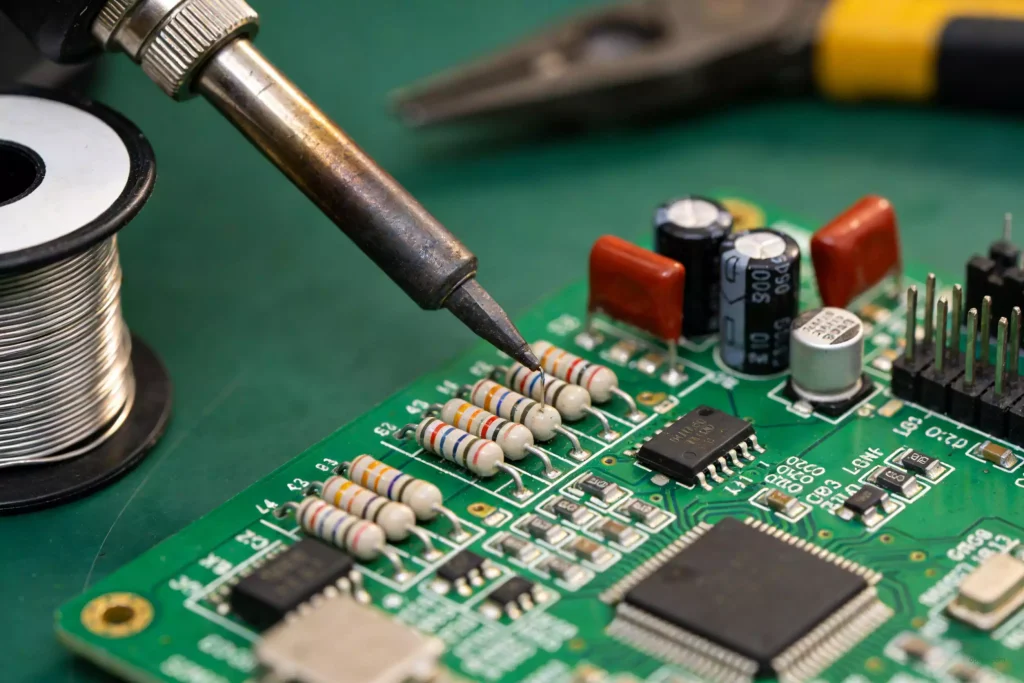
This is where the board comes to life: components are soldered onto the bare PCB.
Most factories use automated SMT (surface mount technology) for speed and accuracy, though some larger components still require manual soldering.
The PCBA assembly process is make-or-break—poor soldering leads to product failures down the line. If you want to clarify the differences between these two common terms, see our guide: PCB vs PCBA: Key Differences and Definitions.
4. Testing & Debugging
After assembly, the PCBA undergoes rigorous testing.
Engineers check for short circuits, component malfunctions, and whether the board performs as intended.
Debugging is common here—small issues like misplaced components or faulty solder joints are fixed before moving forward.
Skipping this step is a mistake we’ve seen cost companies time and money.
5. Enclosure Manufacturing & Final Assembly
Finally, the tested PCBA is placed into a custom enclosure.
The enclosure is designed to protect the board, fit the product’s form factor, and meet user ergonomics.
Once the PCB is housed, the product goes through a final quality check before it’s ready to be released to the public.
Key Components of a PCBA
To understand the electronic product launch process, you need to know what’s inside the PCBA itself.
These components work together to power the device, and we use them daily in our production:
- Basic passive components: Resistors, capacitors (the most common parts in any PCB).
- Active components: Inductive coils, potentiometers, transformers, crystal diodes, and transistors.
- Specialized parts: Field-effect tubes, electro-acoustic devices, optoelectronic devices, sensors, surface-mount components, silicon controllers, switches, relays, and connectors.
Not every product uses all these—we tailor the component list to the device’s function, whether it’s a simple sensor or a complex smart gadget.
Launching an electronic product takes teamwork, attention to detail, and expertise in every step—from design to assembly.
If you’re navigating the electronic product launch process and need support with PCBA design, assembly, or testing, OPCBA is here to help.
We handle the technical heavy lifting so you can get your product to market smoothly.