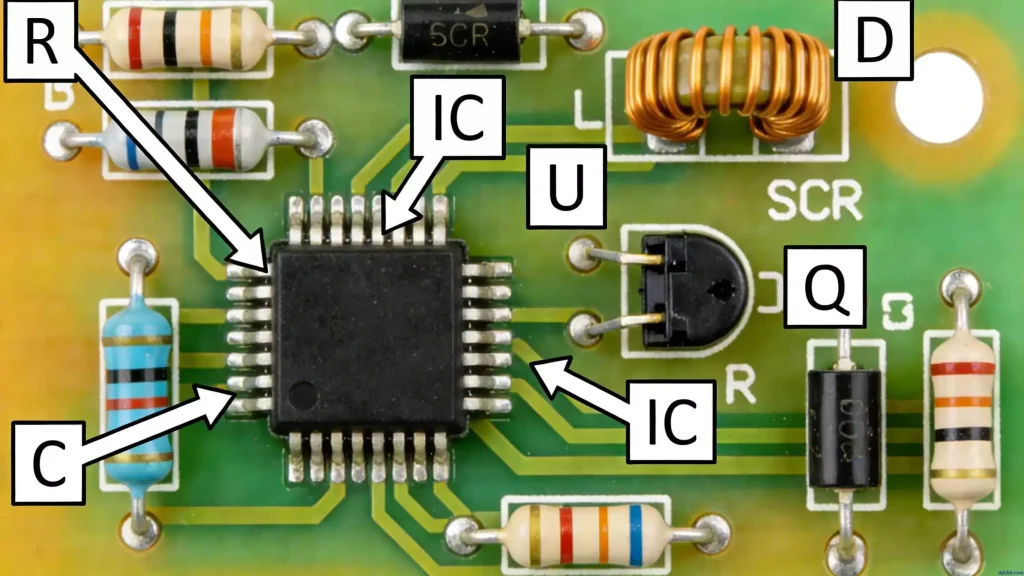
Aluminum substrate boards earn their place where heat decides whether the product survives. The advantages usually listed for them, better cooling, mechanical stiffness, current capacity, all trace back to how the board is built. Read the cross-section and the rest follows.
This page walks through what each layer of an aluminum board does, which advantages show up in a finished design, where those advantages get used, and the cases where a metal core is the wrong call. If your question is instead whether to move an existing FR-4 design across and what that costs, the numbers are on our aluminum PCB versus FR-4 comparison.
The Cross-Section Behind Every Advantage
An aluminum substrate is a three-layer sandwich, and every layer carries one job.
- Copper circuit layer: carries the current. Foil weight typically runs from 1 oz to 6 oz (35 to 210 µm), with the heavier end reserved for high-current work.
- Dielectric layer: electrically insulating but thermally conductive, usually rated 1 to 3 W/m·K. It is the only path heat has from the copper into the base, so its conductivity sets the ceiling for the whole design.
- Aluminum base layer: the metal core, commonly a 5052 or 6061 alloy, with thermal conductivity around 200 W/m·K. It spreads heat and gives the board its rigidity at the same time.
Those ranges are typical values published for metal-core laminates, and the datasheet for the grade you specify governs the final number.
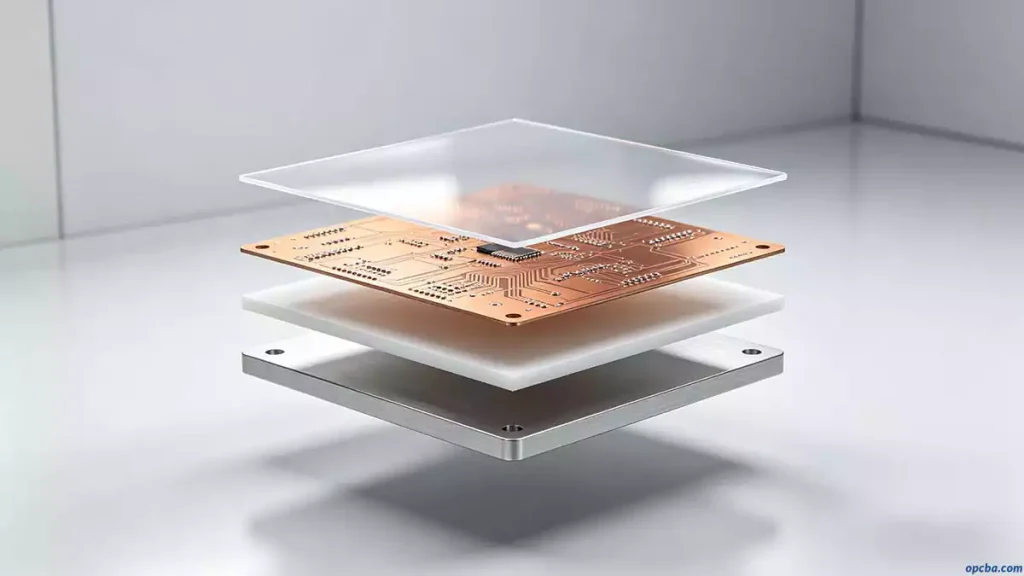
What a power design needs is the whole flooded area working as a heat path, not a handful of drilled points. On a conventional board, heat from a hot component travels down through vias into the plane beneath. On an aluminum substrate the pads sit directly on the dielectric, and the base under them conducts in every direction at once. The cooling advantage comes from the material stack itself.
Thermal Advantages in Practice
FR-4 conducts heat at roughly 0.3 W/m·K, about a tenth of a typical aluminum dielectric, and an aluminum core spreads heat some 8 to 10 times faster. Across the full stack, thermal resistance commonly lands between 0.5 and 3.0 °C/W.
Two things follow for a real product. Junction temperature drops at the same drive level, which for LEDs means slower lumen depreciation and for power devices means more margin against the derating curve. And the thermal path stays short under a component that is already hot, so a dense cluster of emitters or MOSFETs does not build the hot spot a via array would. Our breakdown of thermal resistance in an aluminum substrate stack covers how those figures are derived.
Beyond Heat: What Else the Metal Core Does
Three further advantages come with the same construction.
- Stiffness. An aluminum core is far more rigid than an FR-4 sheet of the same thickness. Long, narrow boards such as LED strips hold their shape through reflow and through thermal cycling in the field, which matters when the light engine is also a structural part.
- Thickness. The metal core is the heatsink, so the design no longer needs a separate one bolted on. A 1.0 to 3.0 mm aluminum board can replace an FR-4 board plus an extruded heatsink stack, and the assembly gets thinner even though the board itself is denser.
- Current capacity. Heavy copper on a metal base carries more current than a thin FR-4 foil, which is what makes aluminum practical for motor drive stages where wide traces are required anyway.
There is a reliability angle as well. Every material interface adds thermal resistance and a potential failure point, so removing the discrete heatsink removes a mounting interface, its hardware and its thermal interface material. For a closer look at how those layers are built, see what each layer of an aluminum substrate does.
Where Aluminum Boards Earn Their Place
The applications below share one trait: heat has nowhere else to go.
- LED lighting. Street lights, high-bay fixtures and COB arrays are the classic case. The dielectric grade follows the power, with 1 W/m·K enough for a low-power strip and 2 to 3 W/m·K needed once the array runs bright.
- Automotive electronics. LED headlamps, onboard chargers and power modules combine heat with vibration and wide temperature swings, a mix a metal core handles better than a laminated board.
- Power conversion. DC-DC converters, AC-DC supplies and inverters put the switching stage on a surface that spreads its losses instead of trapping them.
- Motor drives and industrial control. Drives and servo stages pass real current through their copper, and the base gives the heat somewhere to go.
- Consumer and appliance electronics. High-power control boards in small enclosures use the metal core as the only cooling surface available to them.
The common thread is a design that runs hot, runs tight on space, and is expected to last. Where two of those three hold, an aluminum substrate usually makes sense.
Choosing the Stack-Up That Delivers the Advantage
Four choices in the build decide how much of that advantage you collect.
- Dielectric conductivity: 1 W/m·K for moderate heat, 2 to 3 W/m·K when the devices run hard.
- Copper weight: 2 oz (70 µm) and up for power work, up to 6 oz where the current demands it.
- Base thickness: 1.0 to 3.0 mm. Thicker metal spreads heat better and adds stiffness, at the cost of weight.
- Alloy: the 5000 series (5052, 5005, 5083) brings magnesium into the mix for higher tensile strength and elongation than the pure aluminum grades. Our guide to aluminum clad substrate structure and classification covers the families in detail.
Where Aluminum Substrates Are the Wrong Fit
Three situations point away from a metal core.
- High-frequency and RF circuits. A dielectric chosen to conduct heat is not chosen for controlled impedance at microwave frequencies, and the metal base adds loss. PTFE and ceramic laminates are the right materials there.
- Dense multilayer routing. Most aluminum substrates are single-sided or double-sided, so a design needing six or eight signal layers will not fit on one.
- Low-power digital boards. A logic board with no thermal problem gains nothing from a metal core and gives up routing freedom and weight for it.
Aluminum is a specialized material, chosen to match one specific constraint.
Every advantage credited to an aluminum substrate traces back to the copper, the dielectric or the base, and every application where it wins is one where one of them is the bottleneck.
Get an aluminum PCB quote built to your thermal and current spec, or talk to our engineering team about a stack-up that matches your application.