In our work with security equipment manufacturers and autonomous vehicle developers, Lidar PCB consistently emerges as a critical component. It acts as the “eyes” of driverless cars—emitting lasers that bounce back after hitting obstacles to map the vehicle’s surrounding environment.
Lidar can recognize nearby vehicles, pedestrians, and other obstacles, but none of this is possible without its PCB carrier. We often advise clients that Lidar PCB design isn’t just about precision and intact electrical performance; it also needs to balance manufacturability and cost.
At opcba, we specialize in producing Lidar PCB that ensures your design is not just functional, but also cost-effective to manufacture. Looking ahead, we expect Lidar PCBs to gain traction among more electronic R&D companies, especially as security and autonomous technologies advance.
Lidar: A Game-Changer for Modern Security Surveillance
Security surveillance systems are evolving rapidly—becoming more multifunctional, integrated, and intelligent. Traditional single-camera setups can no longer keep up with increasingly complex, diverse security needs.
This is where Lidar steps in, offering a new solution and functional supplement for the security industry. Unlike traditional systems, Lidar-based security solutions don’t just meet basic monitoring and alarm needs—they also address customers’ deeper, more advanced requirements.
In practice, we’ve seen Lidar unlock unique, significant advantages in security surveillance, solving pain points that traditional cameras simply can’t.
What You Need to Know: Security Surveillance & Lidar Basics
Security Surveillance Systems
A typical security system uses fiber optics, coaxial cables, or microwaves to transmit video signals in a closed loop, forming an independent, complete system from camera to display and recording.
It reflects monitored objects in real time, extending the human eye’s observation distance and capabilities. It can operate in harsh environments for long periods, replacing manual monitoring and capturing all on-site events for recording.
When an illegal intrusion triggers the alarm system, the signal is sent to the host, which then activates video recording and monitoring.
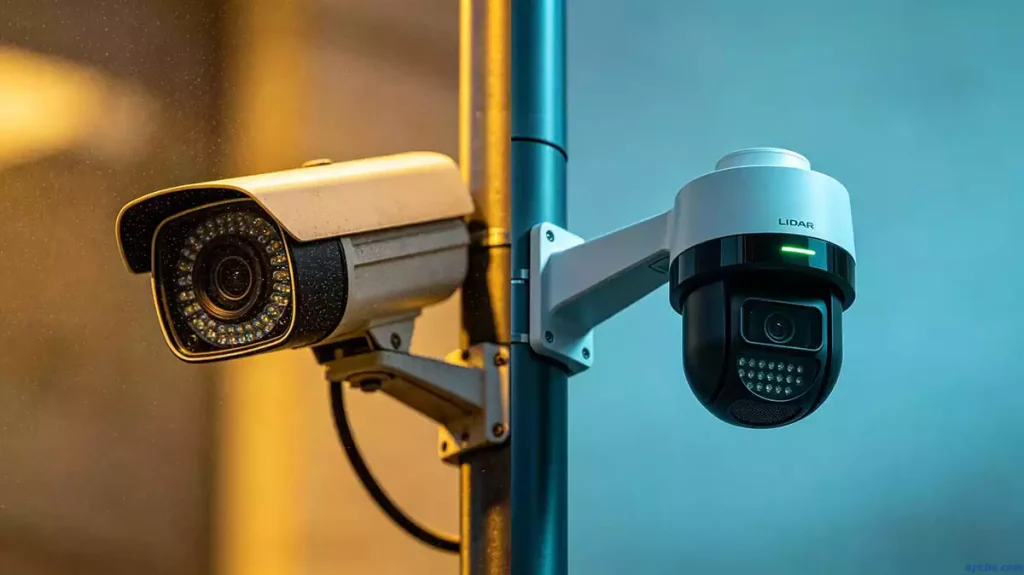
Lidar Technology
In simple terms, Lidar is a radar system that emits laser beams to detect a target’s position, speed, and other characteristics. Its working principle is similar to microwave radar, but with key differences.
It sends out detection signals (laser beams), receives the reflected echo, and compares it to the original signal. After processing, it extracts target information—distance, bearing, height, speed, and even shape—for detecting, tracking, and identifying targets like aircraft and missiles. For a foundational understanding of high-frequency signal processing in similar systems, explore our guide: What is RF Microwave PCB? Materials, Design & Real-World Applications.
Lidar uses infrared and visible wavelengths, with lasers as its working beam. It consists of a laser transmitter, optical receiver, turntable, and information processing system—converting electrical pulses to light pulses for emission, then converting reflected light pulses back to electrical signals for display.
Key Advantages of Lidar in Security Surveillance
From our experience, Lidar’s advantages make it ideal for security applications—here’s what stands out most:
1. Strong Anti-Interference Capabilities
Lidar uses an active laser pulse scanning mode, so it doesn’t rely on ambient light or require additional light sources. Whether day or night, it maintains stable monitoring regardless of light changes.
It also integrates various software and hardware anti-environmental interference measures, ensuring reliable operation in harsh outdoor conditions—something we’ve verified with numerous client projects.
2. Convenient Installation & Versatility
Unlike systems that rely on far-infrared sensing, Lidar detects both human bodies and ordinary objects—even intruders wearing infrared shielding clothing can be reliably identified.
It accurately distinguishes between restricted and open areas, reducing false alarms from open-area personnel activities. Compared to leaky cables, it’s compact, easy to install anywhere, and a single sensor covers a large area. Its small size also allows for concealed installation, reducing effort.
Users can flexibly set the monitoring area’s shape and easily switch parameters in different working modes—adding to its practicality.
3. High Precision & Accuracy
Lidar uses laser beams, which have a much higher operating frequency than microwaves—resulting in exceptional resolution. It detects both moving and stationary objects with precision.
It can also set multiple independent monitoring areas and outputs for different purposes. When an intruder is detected, it provides accurate location information, which can be paired with a video system for real-time tracking and focusing—critical for security response. For insights into how high-frequency antenna technology enhances precision sensing in specialized security setups, check out our guide: Medical RF Antennas.
For reliable Lidar PCB for security surveillance fabrication that meets high-precision requirements, contact opcba. We’ll ensure your Lidar PCB design translates seamlessly into production, supporting your security or autonomous vehicle projects.