In automated surface mount lines, warped or non-flat circuit boards trigger a cascade of production issues.
They cause inaccurate positioning, failed component placement on through-holes and SMD pads, and can even damage automatic insertion machines.
After reflow, bent boards make it nearly impossible to trim component leads evenly.
Warped PCBs also can’t fit into chassis or machine sockets, creating major headaches for assembly plants.
As SMT technology advances toward higher precision, speed and intelligence, flatness requirements for PCBs have grown stricter.
IPC standards specify a maximum allowable warpage of 0.75% for PCBs with surface mount devices, and 1.5% for non-SMD boards.
PCBs are laminated from copper foil, resin, and glass cloth—materials with mismatched physical and chemical properties.
This creates residual thermal stress after pressing, which is the root source of most PCB distortion.
Additional processing steps like high-temperature exposure, mechanical cutting, and wet processing also impact board flatness.
Addressing these variables is one of the most complex challenges for PCB manufacturers.
Root Cause Analysis of PCB Warpage
Understanding PCB warpage causes starts with breaking down the most common triggers seen in real production.
Uneven Copper Distribution Across the Board
Large, unbalanced copper foil areas (typically ground planes or Vcc layers) are a top cause of board warping.
When copper is not evenly distributed across a PCB, heat absorption and dissipation rates vary across the board surface.
This creates uneven thermal expansion and contraction, which builds stress and leads to deformation.
If the board temperature exceeds its Tg (glass transition temperature), the material softens, worsening warpage and even causing permanent deformation.
Via Constraints on Thermal Expansion/Contraction
Multilayer PCBs rely on through-holes, blind vias and buried vias to bond layers together.
These connection points act as physical constraints, limiting the board’s natural thermal expansion and shrinkage during temperature changes.
In practice, this is a frequent pain point for high-density multilayer boards with thousands of vias.
Board Weight-Induced Sagging
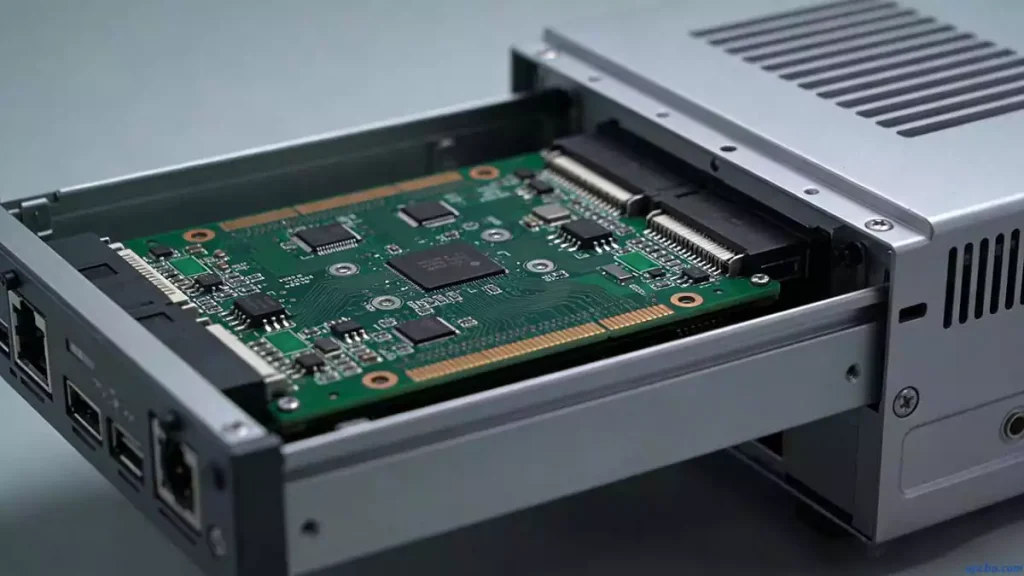
During reflow, PCBs are supported only by their edges on the oven’s conveyor chain.
Oversized boards, or those with heavy components, will sag in the middle under their own weight.
This sagging turns into permanent board bending after cooling.
V-Cut and Breakaway Tab Impacts
V-Cut scoring is a common method for panelization, but it cuts grooves into the original board structure.
This weakens the panel’s mechanical integrity, making the board far more prone to deformation along the scored lines.
Practical PCB Distortion Improvement Methods
These PCB distortion improvement methods are field-proven in mass production, balancing effectiveness and manufacturing cost.
Reduce Thermal Stress From Reflow Processes
Lowering reflow oven temperature, or slowing the heating and cooling ramp rates, is the simplest way to reduce warpage.
This minimizes uneven thermal expansion across the board, cutting down stress that leads to bending.
Use Higher Tg Substrate Materials
Tg is the temperature where the substrate transitions from a glassy state to a rubbery state.
Low-Tg materials soften faster in the reflow oven, staying flexible longer and deforming more easily.
High-Tg boards have far better deformation resistance, though they do come with a higher material cost.
Optimize Board Thickness for the Application
Thinner boards (0.6mm, 0.8mm, 1.0mm) are increasingly common for lightweight designs, but they are far more prone to warping in reflow.
If warpage is a consistent issue, increasing board thickness is a reliable solution, even if it adds slight weight.
Adjust Panel Size and Orientation
Larger panels sag more under their own weight during reflow.
Reducing panel size, or orienting the board’s long edge parallel to the conveyor direction, minimizes mid-panel sag.
For most designs, placing the narrow edge perpendicular to the reflow direction delivers the lowest deformation.
Use Reflow Carrier Fixtures
Reflow trays hold the board flat through the entire heating and cooling cycle, until the board cools below its Tg and re-hardens.
For severe warpage issues, a top-and-bottom clamping fixture can lock the board in place, eliminating almost all deformation.
Modify Panelization Design
V-Cut scoring severely weakens panel structure.
Reducing V-Cut depth, or switching to tab-routed panelization with stamp holes instead of V-Cuts, preserves the board’s mechanical strength and reduces warpage.
For more details about PCB design and manufacturing solutions, visit OPCBA to send your inquiries.