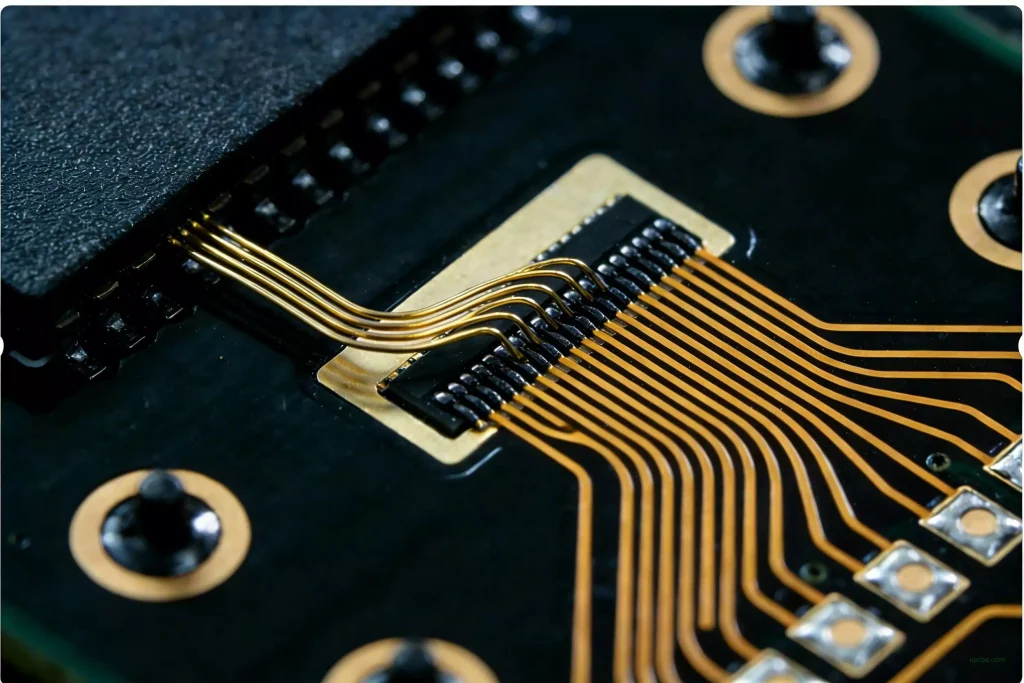
If you work with consumer electronics—cell phones, notebooks, digital cameras—you’ve probably handled FPCB without realizing it. Short for flexible printed circuit board (or FPC), these are thin, lightweight circuits built on polyimide or polyester film substrates.
Unlike rigid PCBs, they’re designed to bend and fit into tight, complex spaces—think the foldable phone hinges or the slim connections inside a digital camera. Their high wiring density, thin profile, and light weight make them irreplaceable in modern compact devices.
Core Traits of Flexible Circuit Boards
The biggest advantage of a flexible circuit board is its flexibility, but that’s just the start. We often joke in the factory that FPCs are the “shape-shifters” of the PCB world—they adapt to the device, not the other way around.
They’re also incredibly reliable, even with repeated bending. Key traits we prioritize in production:
- Short assembly time (fewer components mean faster setup)
- Smaller volume than rigid PCBs (critical for slim devices)
- Lighter weight (ideal for portable electronics like PDAs or LCMs)
- Thin profile (fits where rigid boards can’t)
Basic Structure of FPCB
Break down an FPCB, and you’ll find four core components—each critical to its performance. We’ve learned through years of production that cutting corners on any of these leads to failures down the line.
Copper Film
The conductive backbone of the FPCB, available in two common types: electrolytic copper and calendered copper. Most projects use 1oz, 1/2oz, or 1/3oz thicknesses—we pick based on the device’s current needs.
The copper film sits on a substrate film (usually 1mil or 1/2mil thick), bonded by adhesive whose thickness is tailored to the customer’s specs. No one-size-fits-all here—every project needs a custom mix.
Cover Film
This layer insulates the circuit, preventing short circuits. Common thicknesses are 1mil and 1/2mil, paired with adhesive (again, customer-specific). A release paper protects the adhesive until pressing—skip this, and you’ll get debris stuck in the glue, ruining the board.
PI Stiffener Film
Flexibility is great, but some areas need rigidity—like where components are mounted. PI stiffener film (3mil to 9mil thick) adds mechanical strength, making surface mounting easier. It also uses adhesive with a release paper, same as the cover film.
EMI Shielding Film
For devices in high-electromagnetic environments (like cell phones near routers), EMI film blocks outside interference. It’s not always required, but we recommend it for any FPCB used in communications devices.
FPCB Manufacturing Process: The Key to Quality
A good FPCB manufacturing process isn’t just a list of steps—it’s a series of checks to avoid costly mistakes. In real production, pre-production pretreatment is where we catch most issues before they become batch failures.
Pre-Production Pretreatment (Make or Break Step)
Our engineers handle three critical tasks here, and skipping any leads to headaches later:
- Engineering evaluation: Can we actually produce the customer’s FPCB? Does our capacity match their requirements? What’s the unit cost? No guesswork—we run tests to confirm.
- Material preparation: Sourcing the right polyimide film, copper foil, and adhesive is non-negotiable. We don’t cut corners on materials—cheap substrates lead to brittle boards that crack during bending.
- Document processing: We tweak the customer’s CAD drawings and Gerber files to fit our production equipment. Misaligned files are the #1 cause of drilling errors, so this step gets extra attention.
Once pretreatment passes, we send production drawings and MI (process cards) to the floor—then the real work begins.
Single-Panel FPCB Process
The simpler of the two, but still requires precision:
Open material → Drilling → Dry film application → Alignment → Exposure → Developing → Etching → Stripping → Surface treatment → Covering film pressing → Curing → Immersion nickel gold → Character printing → Cutting → Electrical testing → Punching → Final inspection → Packaging → Shipment
We’ve found that etching and stripping are the most error-prone steps here—too much etching eats away at copper, too little leaves excess material that causes shorts.
Dual-Panel FPCB Process
Adds PTH (plated through-hole) and extra plating steps to connect both sides:
Open material → Drilling → PTH → Plating → Pre-treatment → Dry film → Alignment & exposure → Developing → Graphic plating → Stripping → Second pre-treatment → Dry film → Alignment, exposure & developing → Etching → Stripping → Surface treatment → Covering film pressing → Curing → Immersion nickel gold → Character printing → Cutting → Electrical testing → Punching → Final inspection → Packaging → Shipment
Dual-panel boards need extra care with PTH plating—poor plating leads to weak connections between layers, which fail under repeated bending.
Why FPCBs Matter for Modern Electronics
From foldable phones to medical devices, FPCB is the unsung hero of compact, high-performance electronics. Their flexibility, reliability, and small form factor make them impossible to replace in today’s slim, portable designs.
If you’re working on a project that needs custom FPCBs—whether single or dual-panel—our team has the experience to get it right. Reach out to discuss your specs, and we’ll walk you through the process from pretreatment to shipment.