Automotive Cable: 0.50mm², 300V, Built to ISO 6722 Class B
When routing signals through a vehicle harness, the cable itself is rarely the most expensive component in the system—but it can become the most expensive source of field returns if it wasn’t specified correctly. A thin-wall automotive cable that meets ISO 6722 Class B is engineered for the thermal, mechanical, and chemical environment under a dashboard, inside a door, or along a chassis rail. This is a cable designed to disappear into the background and never be the reason for a warranty claim.
Our standard automotive cable in this configuration is a single-core, unshielded design rated for 300V and a continuous operating temperature from –40°C to +105°C. The cross-sectional area of 0.50 mm² is targeted at signal-level and low-power circuits: sensor lines, actuator control, interior lighting, switch panels, and diagnostic connections.
Conductor and Insulation
The conductor uses bare copper (Cu-ETP1) in a 16-strand construction, each strand 0.20 mm in diameter. This gives a nominal cross-section of 0.50 mm². Stranded copper provides the flexibility needed for harness routing without compromising conductivity. Solid conductors of the same cross-section would be stiffer and more prone to work-hardening fatigue in vibrating environments—a real concern inside a vehicle that sees years of thermal cycling and road vibration.
The insulation is polyvinyl chloride (PVC), applied as a thin-wall layer. Thin-wall insulation keeps the overall cable diameter small—essential in modern vehicles where harness bundles run through increasingly tight spaces—while still providing the required dielectric strength for 300V circuits. PVC is the industry standard for this temperature class because it processes easily, resists abrasion, and maintains flexibility across the operating range. The maximum outer diameter is 1.50 mm, which makes this thin-wall automotive cable easy to route into compact connectors and through narrow grommets.
Shielding and EMC
This cable is unshielded by design. For many sensor and actuator circuits inside a vehicle, the common-mode noise environment does not justify the added cost, weight, and diameter of a shielded construction. Where shielding is required—for CAN bus, Ethernet, or other differential pairs—we specify a different cable construction with foil and braid. For a general-purpose signal line, unshielded is the right balance of cost and performance. We note the shielding choice explicitly because it is one of the most common questions during harness design: “Do I need a shield on this?” The answer depends on the signal, the impedance, and the proximity to noise sources. If you’re unsure, our engineering team can walk through the trade-offs.
Thermal and Flame Performance
The –40°C to +105°C operating range is a standard automotive temperature envelope, commonly referred to as a T4 class in ISO 6722 terminology. This covers engine bay peripherals where ambient temperatures can reach 105°C, as well as cold-crank conditions at –40°C. The PVC compound maintains flexibility at the low end without cracking, and does not soften excessively at the high end.
Flame retardancy is tested according to ISO 6722. In the event of a vehicle fire, the cable must self-extinguish within 30 seconds of the flame being removed and must not propagate combustion along the harness. This is a requirement driven by functional safety: a cable that acts as a wick turns a local electrical fault into a vehicle-wide fire. Our ISO 6722 cable meets this requirement without halogenated flame retardants that would produce corrosive gases during combustion.
Mechanical Constraints
The minimum bending radius for fixed installation is 6 times the outer diameter. With a maximum OD of 1.50 mm, this gives a minimum bend radius of 9 mm. In practice, harness designers target a larger radius to leave margin. Violating the bend radius at a connector backshell or a tight routing corner can crack the insulation or displace the conductor strands, creating a latent failure that may not show up until the vehicle has been on the road for months. If the routing demands a tighter bend, a cable with a smaller OD or a more flexible construction should be considered—not a tighter bend on the same cable.
Compliance and Documentation
The cable is manufactured to ISO 6722 Class B, which covers dimensional, electrical, mechanical, thermal, and flame propagation requirements for single-core 300V cables used in road vehicles. Full test data is available upon request.
Applications
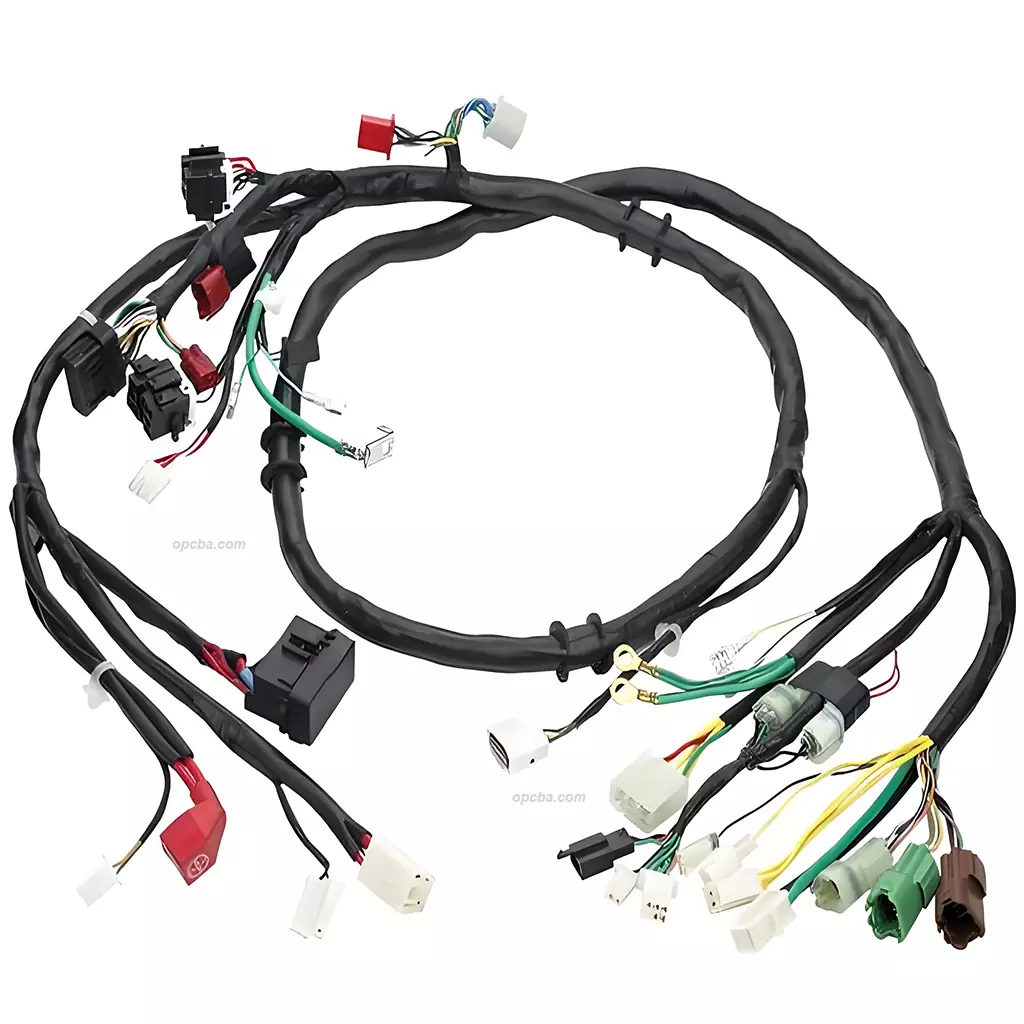
This automotive cable is used in vehicle internal wiring harnesses for sensors, actuators, interior lighting, control switches, diagnostic ports, and other low-power circuits where 0.50 mm² cross-section is appropriate for the current and voltage drop budget. It is not intended for high-current applications (battery cables, alternator circuits) or for external exposure without additional protection.
Ordering
Every cable we supply is cut to length and terminated according to your harness specification. To request a quotation, send your cable requirements to sales@opcba.com. Include the desired length, end treatments (stripping, tinning, terminal crimping), and any additional marking or packaging needs. We’ll return a quote with a lead time as soon as the specification is reviewed.