High-Density Wiring & Superior Electrical Performance for PCB
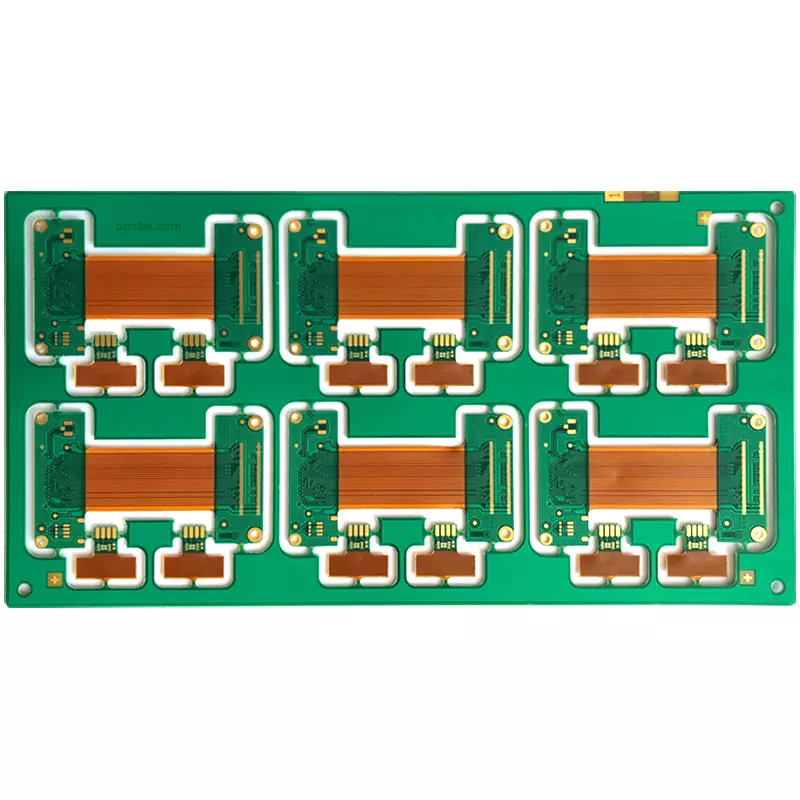
Overview of Rigid-flex PCB
Rigid-flex PCBs feature flexible regions.
These regions can be bent, folded, twisted, or laminated at will.
They adapt to complex 3D installation spaces in electronic products.
This design reduces the overall volume and weight of the device.
It also cuts assembly steps, lowers contact failure risks, and boosts electronic system reliability.
Structural Composition
A rigid-flex PCB has two main structural components.
Flexible Core Substrate: This is the “flexible backbone” of the board.
It is typically made of high-performance polymers like polyimide (PI) or polyethylene terephthalate (PET).
Rigid Core Substrate: This acts as the load-bearing base for mounting components.
It uses standard rigid PCB materials, such as high Tg FR-4, ceramic-filled FR-4, or metal core substrates (MCPCB).
Key Design Considerations
Designing a rigid-flex board requires careful attention to both regions.
Flexible Area Design: Prioritize rolled copper foil to prevent cracking.
Ensure circuit lines run parallel to the bending direction.
This minimizes tensile and compressive stress on the conductors.
Rigid Area Design: Match the hardness of the rigid section to connected circuits.
Ensure the board width meets structural requirements.
Multi-Field Applications
Rigid-flex PCBs use a reliable, space-efficient combined plate structure.
They are extremely compact and fit perfectly into 3D irregular layouts.
These boards adapt to the 3D internal spaces of many devices:
-
Consumer electronics: Folding screen hinges
-
Automotive electronics: Irregular on-board modules
-
Medical equipment: Portable curved bodies
They are built with high-toughness PI substrates, rolled copper foil, and an integrated pressing process.
This construction lets them withstand over 100,000 dynamic bends.
They also offer strong anti-vibration and shock resistance.
This makes them ideal for high-stress scenarios:
-
Automotive electronics: Withstanding vehicle jolts
-
Aerospace: Resisting extreme vibrations
-
Industrial control: Handling equipment operation vibrations
They also meet the durability needs of consumer electronics, such as daily drops and folding.
Material Selection & Cost Reference
Material selection for rigid-flex PCBs varies by region.
Rigid Board Area: High Tg FR-4 is the top choice for most applications (over 80% usage).
High Tg FR-4 (Tg ≥ 170℃) resists soldering temperatures and has excellent dimensional stability.
It works well for consumer electronics, automotive electronics, and other common scenarios.
Flexible Board Area: Polyimide (PI) and polyester (PET) are the main options.
PI is the industry standard, used in over 90% of cases.
It offers excellent thermal resistance (operating from -40℃ to 125℃, withstanding soldering over 260℃).
PI also has strong bending toughness, supporting over 100,000 dynamic bends.
It is ideal for consumer electronics, automotive electronics, and other mainstream uses.
PET is a low-cost alternative but has poor thermal resistance and bending performance.
It is only used in simple household appliances and low-precision sensors.