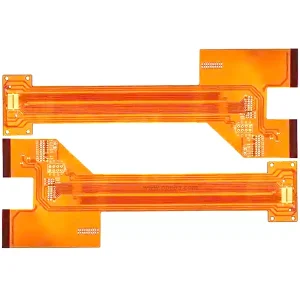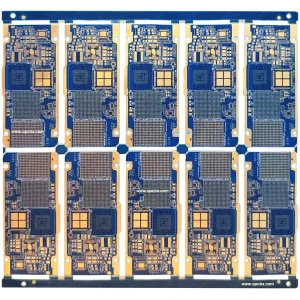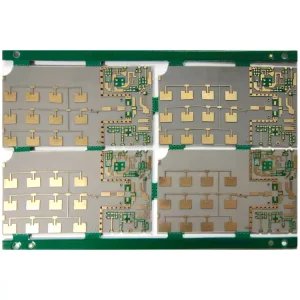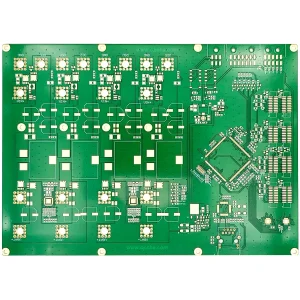
Overview of Multilayer PCB
A multilayer PCB is any board built from four or more conductive layers, bonded with insulating material between them. Layer count comes out of the design work: it depends on how much routing has to fit, how many supply rails the board carries, and whether high-speed nets need controlled impedance.
Structural Composition
Copper foil and insulating material alternate through the stack. The insulating layers are either rigid cores, which carry copper on both faces, or prepreg sheets that bond the cores together during pressing. A four-layer board needs one press cycle; each additional pair of layers generally adds another, and the cores get thinner as the count rises. Our printed circuit board basics page covers the substrate and copper layers in more detail.
Key Design Considerations
Most multilayer problems trace back to decisions made before routing starts.
- Derive the layer count from the routing. Estimate the routing channels and plane requirements first, then choose the smallest stack that fits.
- Stack symmetry controls warpage. A build that is not mirrored about the center will bow during reflow.
- Every high-speed trace needs an adjacent reference plane, and that plane has to stay continuous under the trace.
- Via technology is a cost lever. Through-hole vias are the baseline, blind and buried vias free inner-layer routing area, and microvias move the board into HDI territory with its own premium.
Multi-Field Applications
Layer count tracks application complexity closely:
- Four layers: general industrial controls and simpler consumer products.
- Six layers: dense consumer devices, wearables, and automotive control modules.
- Eight layers: networking equipment, computers, and multi-rail industrial systems.
- Ten layers and above: servers, medical imaging, avionics, and satellite hardware.
Material Selection & Cost Reference
Substrate choice runs from standard FR-4 through high-Tg grades to low-loss and specialty laminates. FR-4 covers most multilayer work; Rogers-class materials multiply the material line when a design calls for them.
Cost does not scale linearly with layer count, so it helps to know where the steps fall. Taking a standard four-layer board as 1.0:
- Six layers: about 1.5 to 1.8 times.
- Eight layers: about 2.2 to 2.8 times.
- Twelve layers: about 3.5 to 5 times.
Each additional pair of layers adds roughly 40 to 70 percent. The jumps come from lamination cycles, tighter registration, and yield loss.
The ranges above are drawn from published 2026 China-manufacturer pricing for standard FR-4 boards at 100-piece volume.