A floor fan lives in the background of daily life. It runs for hours in living rooms, bedrooms, and home offices, often while people sleep or work. The motor should be heard as moving air, not as a whining stator or a clicking bearing. It should spin smoothly from a gentle breeze to a strong gust, without hum or flicker. And it should survive the occasional tip-over, dusty intake, or voltage dip without complaint.
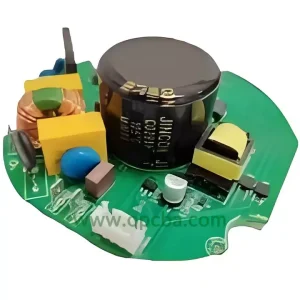
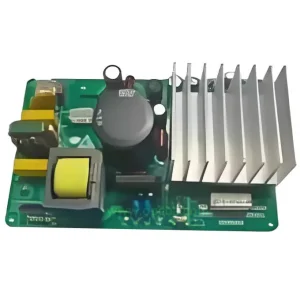
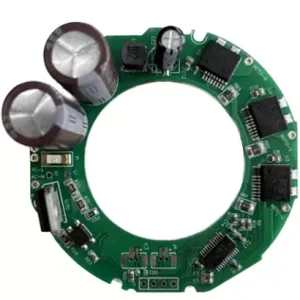
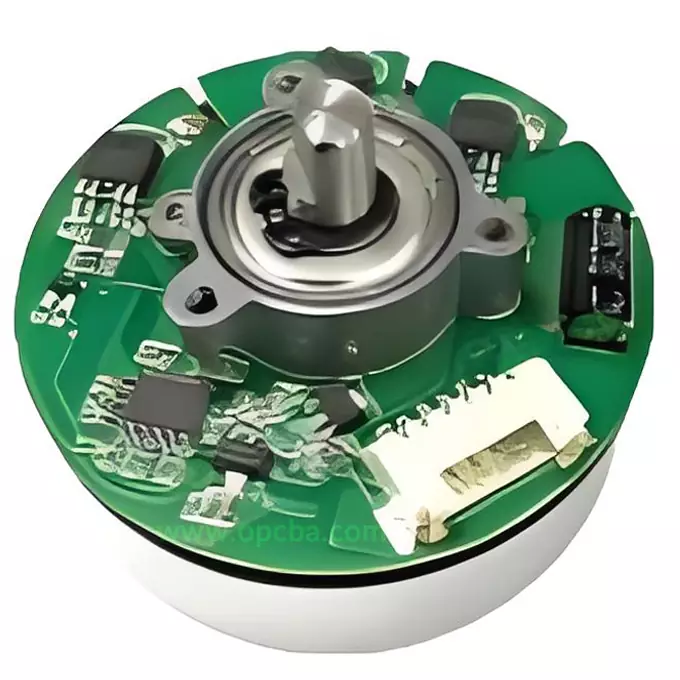
This floor fan solution is a dedicated BLDC motor controller built around sensorless field-oriented control. It drives a 24V, 30W motor at up to 1,500 RPM, using PWM for infinite speed adjustment, and holds the set speed constant even as the filter loads up or the line voltage wavers.
Quiet by Design
Sensorless FOC drives the motor with sinusoidal phase currents instead of the trapezoidal commutation used in cheaper fans. The result is less torque ripple, less vibration, and none of the tonal whine that cheap BLDC controllers produce at low speeds.
For a floor fan, this matters most at night. At the lowest speed setting, where a trapezoidally driven motor might produce an audible 500 Hz hum, the FOC waveform keeps the magnetic flux smooth and the noise floor low. Combined with constant-speed regulation, the fan delivers the same airflow at setting “1” on day one and day one thousand, regardless of bearing wear or filter dust.
Infinite Speed Control, Not Just Three Clicks
Many floor fan controllers offer three or four fixed speeds. This one uses a PWM input to give the user smooth, continuous speed adjustment from zero to 1,500 RPM. The PWM duty cycle maps linearly to motor speed, so the fan can emulate a stepless dial, a touch slider, or a remote-controlled setting—whatever the product design calls for. The motor doesn’t care whether the speed command comes from a potentiometer, a microcontroller, or a wireless module; it follows the PWM signal.
Constant-speed operation means the controller compensates for load changes automatically. If the user places the fan against a curtain or the intake grille collects dust, the motor draws slightly more current to maintain the same RPM rather than quietly slowing down.
Protection That Keeps the Fan Running
A floor fan PCBA needs to be as resilient as the motor it drives. This controller monitors five fault conditions:
-
Overcurrent protection caps the phase current at a safe limit, preventing winding damage from a stalled blade or a shorted turn.
-
Voltage protection shuts down the controller if the 24V rail sags too low (brownout) or spikes too high (load dump).
-
Locked-rotor protection detects when the impeller is physically blocked and cuts power immediately, before the motor or the drive MOSFETs overheat.
-
Phase-loss protection catches a broken motor wire or a failed MOSFET and stops the output before the remaining phases are overstressed.
-
Startup protection prevents repeated restarts into a fault condition. If the fan blade is jammed, the controller tries to spin up a configurable number of times, then latches off until power is cycled.
All protections auto-recover once the fault clears, so a momentary obstruction doesn’t require a manual reset.
What the Numbers Look Like
The floor fan PCBA runs on 24V DC, which is the standard voltage for safe, low-voltage home appliances. It delivers up to 30W to the motor, enough for blade diameters from 300 mm to 400 mm. The speed range spans 0 to 1,500 RPM, adjustable via PWM, with constant-speed regulation holding the setpoint within a tight band.
The same hardware supports different user interfaces: a simple knob with an analog voltage divider, a push-button stepped-speed panel, or a wireless remote with a PWM output. The controller doesn’t dictate the user experience—it just makes the motor do what it’s told, quietly and reliably.
Where This Controller Fits
This floor fan solution is designed for pedestal fans, tower fans, and desk fans where low noise, smooth speed control, and long service life are the selling points. The 24V low-voltage architecture also suits battery-powered or solar-powered fan applications, since the controller can run from a 24V battery bank with no intermediate converter.
If you’re developing a new floor fan and need a motor controller that’s already proven in silent, constant-speed applications, reach out at sales@opcba.com with your motor specifications.We’ll provide a reference schematic, a pre-programmed MCU sample, and layout guidelines to integrate this floor fan controller into your next product. For another example of our compact, low-noise home appliance BLDC control solutions, see our product page: Home hair dryer solution