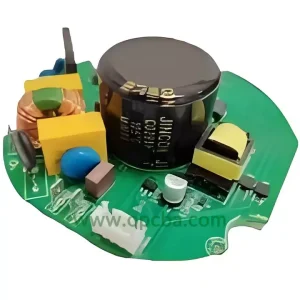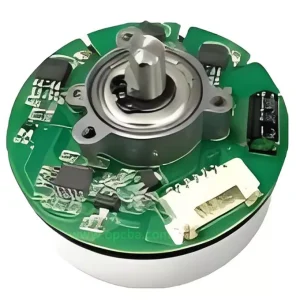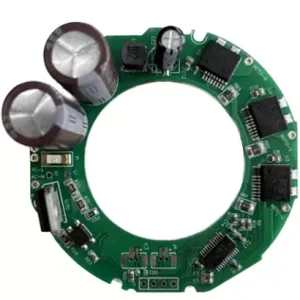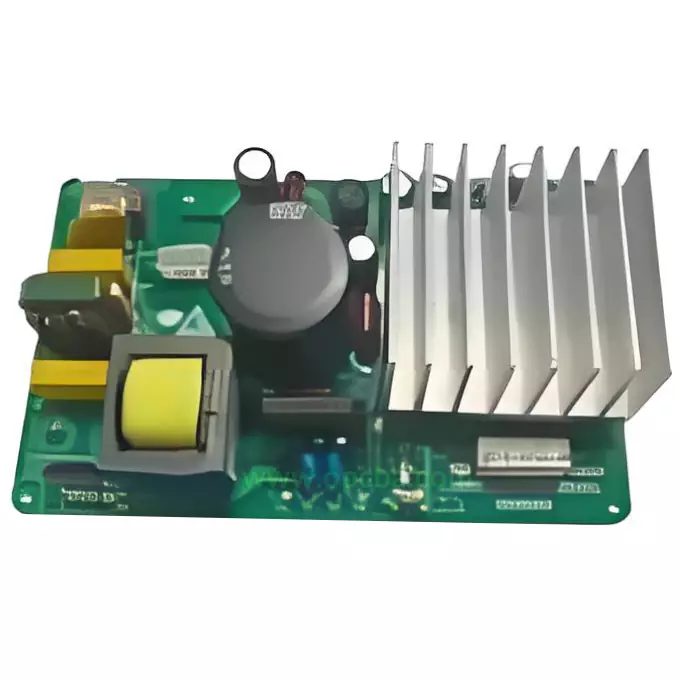
A range hood motor controller operates in one of the harshest environments inside a home. Heat from the cooktop rises directly into the housing. Grease particles suspended in the airflow settle on every surface. Humidity cycles between dry and saturated, sometimes within the same cooking session. And yet the fan is expected to spin reliably, day after day, without whining, without stalling, without tripping.
This range hood solution is a dedicated motor-control PCBA built for that exact environment. It drives a single-phase or three-phase BLDC motor at 200W to 400W, accepts a wide AC input from 100V to 270V, and holds the selected airflow steady regardless of how clogged the filter gets. For more details on our related power solutions for home appliances, see our product page: Electronic power module
Constant Airflow: The Feature That Actually Matters
A basic motor driver will spin the fan at a fixed speed. That works until the grease filter starts loading up. As the filter resistance increases, airflow drops. The user turns up the speed setting, gets more noise but not much more suction, and eventually assumes the hood is underpowered.
This range hood controller runs either voltage-loop or power-loop regulation, depending on the motor type and the fan curve. The core logic is constant-airflow control: as the filter resistance rises, the controller increases motor power to maintain the same air volume through the duct. The user doesn’t need to compensate—the hood delivers the same extraction performance from filter-clean to filter-change.
A current-limitation loop sits underneath the airflow control. If the motor is asked to push beyond its thermal rating—blocked duct, closed damper, or a filter past due for replacement—the controller caps the output current rather than letting the winding temperature climb unchecked.
Protection That Prevents Callbacks
An installed range hood isn’t easy to service. Any fault that damages the motor or the control board means a truck roll, a warranty claim, and an unhappy customer. This range hood PCBA monitors six fault conditions and acts before damage occurs:
-
Overvoltage and overcurrent protection trip within microseconds when the DC bus or motor phase current exceeds safe thresholds.
-
Locked-rotor protection detects a stalled impeller—whether from debris, ice, or mechanical failure—and shuts down output immediately.
-
Phase-loss protection catches a broken motor lead or a failed MOSFET before it cascades.
-
Power protection monitors the total input power against the 400W ceiling, shutting down if the motor draws beyond the rated envelope.
-
Startup protection prevents repeated restart attempts into a persistent fault, latching off after a configurable number of retries.
Each protection mode auto-recovers once the fault clears, with configurable restart timing. For a residential hood, a short auto-restart is usually fine. For a commercial kitchen hood where a fault likely means something physical has gone wrong, the system can latch off until manually reset.
What the Numbers Look Like
The range hood PCBA takes 100V to 270V AC directly, covers the full residential and light-commercial voltage range, and outputs 200W to 400W to the motor. The speed range runs from 1,000 RPM to 3,000 RPM, configurable by the hood manufacturer to match the impeller diameter and the target airflow curve.
The same hardware platform supports multiple user interfaces—analog potentiometer, push-button stepped-speed, or PWM speed-command input—without changing the power stage.
Getting Started
If you’re developing a new range hood solution or replacing an existing drive that isn’t holding up in the field, send your motor specifications and target airflow requirements to sales@opcba.com. We’ll provide a reference schematic, a pre-programmed MCU sample, and the layout files to integrate this range hood controller into your next product.