Industrial fans don’t fail on a convenient schedule. When a tunnel exhaust fan stops, or a factory ventilation system trips, the cost isn’t measured in repair bills—it’s measured in downtime, safety risk, and sometimes regulatory trouble. That’s why the control electronics inside these fans need to be built differently.
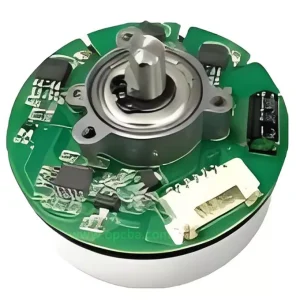
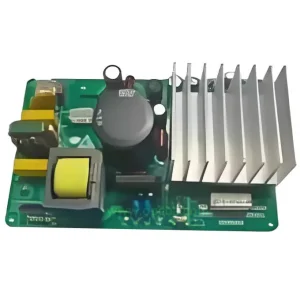
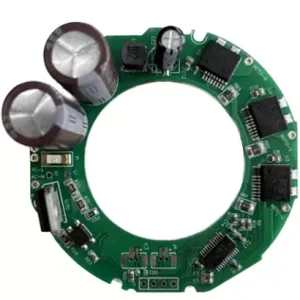
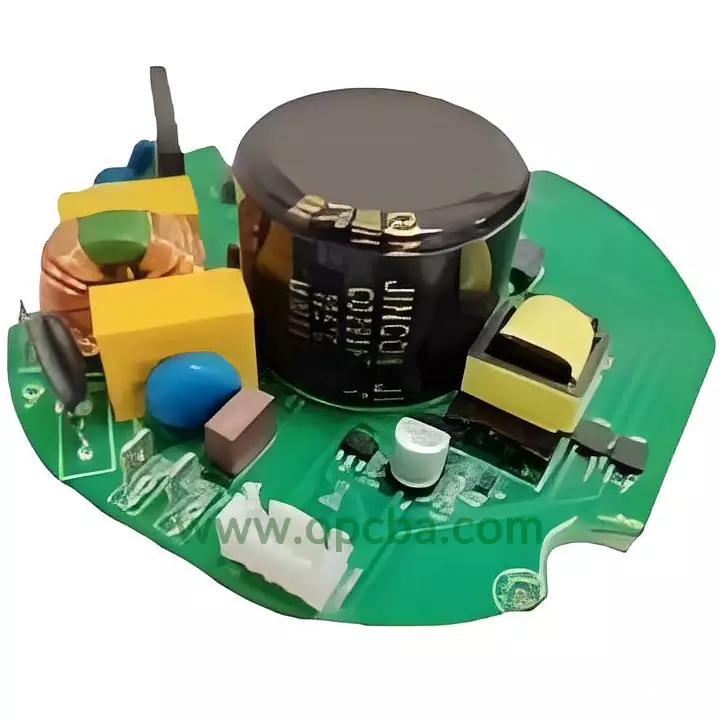
This industrial fan controller is a 300W PCBA solution designed around a dedicated motor-control MCU. It runs sensorless field-oriented control with a claimed 100% startup success rate, maintains constant speed and constant power under fluctuating load, and packs a suite of hardware-level protections that catch faults before they cascade. The input range spans 180V to 300V AC, which means it tolerates the voltage swings common in factory power lines without tripping or resetting.
What “Industrial Grade” Actually Means Here
Off-the-shelf motor drivers work fine on a bench. Put them inside a metallurgy plant fan that cycles on and off ten times a day with 300V ringing on the DC bus, and the failure rate climbs fast. This controller was designed from the start for industrial fans—the kind that run in tunnels, underground garages, chemical plants, and high-temperature exhaust applications.
The design priorities are visible in what’s included and what’s left out. There’s no touchscreen interface, no wireless connectivity, no feature that doesn’t directly contribute to keeping the fan spinning reliably. What’s included: a sensorless FOC algorithm that handles startup under load without back-EMF sensing issues, constant-speed regulation that keeps airflow steady when the line voltage sags, and constant-power control that prevents the motor from pulling more current than the system can thermally handle.
The algorithm side also smooths out phase current ripple and suppresses vibration noise at the commutation frequency. In practice, this means less audible hum from the motor and less mechanical stress on the bearings over time.
Protection That Catches the Fault Before the Fan Stops
The most expensive repair on an industrial fan is the one that could have been prevented. This industrial fan PCBA monitors seven fault conditions continuously:
Overvoltage and overcurrent are the obvious ones—the MCU’s built-in comparator and DAC set precise thresholds, and the controller shuts down within microseconds when either limit is breached.
Locked-rotor protection covers the case where debris or mechanical binding stops the impeller. Instead of dumping current into a stalled winding until something burns, the controller detects the absence of commutation and cuts power immediately.
Phase-loss protection catches a broken wire or a failed MOSFET before it turns into a short circuit through the remaining phases.
Power protection monitors DC bus ripple and input current, shutting down if either exceeds the safe operating area of the output stage.
Startup protection prevents the controller from attempting repeated starts into a fault condition. If the motor can’t spin up after a configurable number of retries, the controller latches off and waits for manual reset.
Blocked air outlet protection senses the pressure differential change that occurs when a damper closes or a duct is obstructed. It either throttles the fan speed or shuts down entirely, depending on how the threshold is configured.
Each protection mode has a configurable auto-restart timer. For a tunnel exhaust fan that must recover from a transient fault without human intervention, you set the timer short. For a foundry fan where a fault likely means something mechanical has failed, you set it long—or latch it off entirely.
What the Numbers Look Like
The industrial fan PCBA accepts 180V to 300V AC directly, rectifies it on-board, and drives a three-phase BLDC motor at up to 300W. The MCU runs the FOC loop with 28kHz PWM. At this switching frequency, the fundamental tone sits above the most sensitive range of human hearing, though some higher-order harmonics may still fall within the audible band. In practice, the stator noise level is low enough that it rarely registers in the typical factory ambient.
Constant-speed control maintains the setpoint RPM within a few percent even as the AC line fluctuates. Constant-power mode caps the motor input at the rated 300W, which is useful when the fan is handling dense or variable air loads where speed control alone could let the motor pull more power than the thermal design allows.
For industrial fans that need to integrate into a building management system or PLC, the controller provides a standard 0-10V or 4-20mA speed command input. A tachometer output (open-drain pulse) gives the host system a direct RPM reading. No proprietary protocol, no software library required.
Where This Controller Fits
The 300W power rating covers a wide range of industrial fans: centrifugal blowers for fume extraction, axial-flow ventilation fans for tunnels and parking structures, small induced-draft fans for boiler exhaust, and condenser cooling fans in refrigeration plants. The wide input voltage and high-temperature design (rated for 105°C ambient) make it a fit for environments where the control board sits close to the motor housing and the ambient air is already hot.
For corrosive environments—chemical plants, coastal installations, wastewater treatment—the PCB can be conformally coated. The connectors are rated for industrial use, and the board outline is kept compact to fit inside standard motor junction boxes.
If you’re sourcing an industrial fan controller for a new design or replacing an existing drive that isn’t surviving the environment, reach out at sales@opcba.com with your motor specifications and operating conditions. We’ll provide a reference schematic, a pre-programmed MCU sample, and the layout guidelines to integrate it into your fan assembly.