Aerospace is an industry defined by uncompromising safety, extreme environmental demands, and rigorous compliance. Even the smallest component failure can have catastrophic consequences.
From commercial aircraft to satellites and rockets, every mission-critical airborne system relies on qualified electronic components. These parts must undergo thorough testing to operate reliably in harsh conditions. These include extreme temperatures, vibration, radiation, and vacuum environments.
In this sector, component qualification and testing are not just best practices. They are mandatory requirements to meet global regulatory standards and ensure public safety. Parts for space and aerospace applications must pass stringent evaluations. These tests prove their resilience, functionality, and longevity—whether for airborne avionics or space-bound satellite systems.
Core Requirements for Mission-Critical Electronic Components
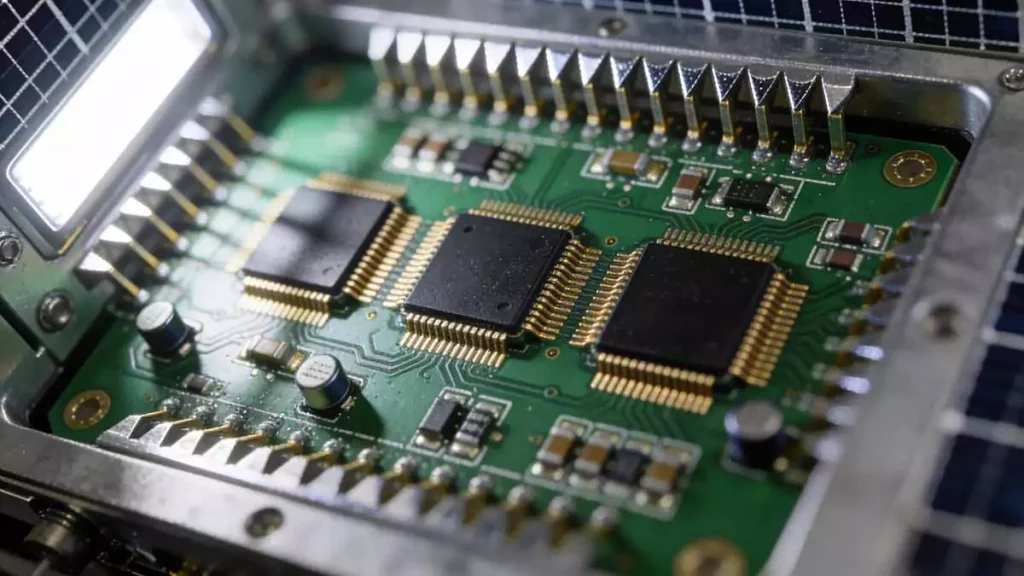
High-reliability electronic components are the backbone of modern aircraft and spacecraft. They have unique requirements that set them apart from commercial or industrial alternatives. These parts must balance performance, durability, and efficiency. This ensures they thrive in the demanding aerospace environment, where failure is not an option.
The primary requirements for aerospace-grade electronic components include:
- Extreme temperature resistance: From -150°C for space applications to 150°C for engine bay components
- Radiation hardening for space missions
- Low power consumption to conserve limited energy sources
- Lightweight miniaturization to optimize fuel efficiency and payload capacity
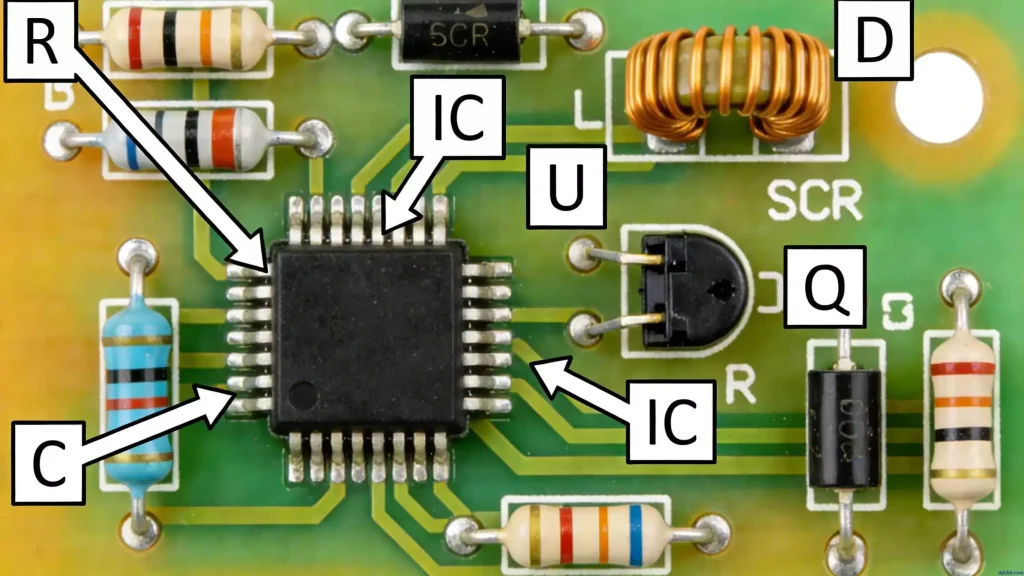
Common parts include integrated circuits (ICs) like FPGAs and DSPs, sensors, power management chips, and wireless communication modules. All are critical to flight control, navigation, and system monitoring.
Critical Testing Protocols for High-Reliability Systems
To ensure parts meet strict reliability standards, they must comply with internationally recognized testing protocols. These standards define environmental, structural, and functional tests. Aerospace components must pass these tests before deployment. This ensures consistency and safety across the global sector.
Key Testing Standards for Aerospace Applications
- RTCA DO-160: A cornerstone standard for airborne equipment. It outlines environmental test procedures for components. These include temperature, altitude, vibration, shock, humidity, and electromagnetic interference (EMI) testing. Compliance with DO-160 is mandatory for any equipment installed in commercial aircraft. It guarantees safe operation in diverse flight conditions.
- MIL-STD-810: A military standard focused on environmental engineering. It is widely used for testing components against extreme temperatures, vibration, shock, and corrosion. It is critical for defense applications and spacecraft components facing harsh launch and orbital conditions.
- Other Critical Standards: Additional standards include IEC 62564 for qualified integrated circuits, NASA-STD-7001 for structural loads, and ASTM standards for material property testing. All work together to ensure component reliability.
Reliability Challenges in Modern Aerospace Engineering
The sector faces unique reliability challenges. These are driven by evolving technologies, compressed timelines, and demand for component reusability. Traditional systems were often single-use. Modern applications—like reusable rockets and long-duration satellite missions—require components to maintain performance over multiple cycles. This increases the complexity of reliability testing.
Other challenges include:
- Use of custom components, which lack predictable performance of off-the-shelf parts
- New manufacturing techniques like additive manufacturing, which introduce unique material properties
- Unpredictability of extreme environments
Even with rigorous testing, systems must account for infinite variables. Comprehensive qualification is essential to mitigate failure risk.
Ensuring Compliance in Component Qualification
Compliance with aerospace standards is not just a regulatory requirement. It is a commitment to safety and reliability. Manufacturers and component suppliers must implement robust process management systems. These ensure every part meets qualification criteria—from design and manufacturing to testing and deployment.
This includes adhering to guidelines from regulatory bodies like the FAA, EASA, and NASA. Regular audits and validation tests are also required. For aerospace-grade components, compliance is a continuous process. Standards are updated to keep pace with technological advancements.
The Future of Component Reliability in Aerospace
As aerospace technology advances, demand for reliable, efficient, and resilient components grows. Trends like electric aircraft, LEO satellite constellations, and autonomous flight drive this need. Innovations in materials science, testing technology, and component design will play a critical role. These will help push the boundaries of what is possible, while maintaining uncompromising safety standards.
Advanced thermal coatings protect components from extreme temperatures. AI-driven testing systems optimize qualification processes. The future of reliability focuses on precision, efficiency, and adaptability. This ensures systems can safely navigate the most challenging environments for years to come.
As a one-stop PCB manufacturing service provider, we design and produce boards optimized for high-reliability components. Our solutions meet the industry’s strictest compliance standards.