LED PCB Board: Aluminum Core for Thermal Performance
LEDs convert only about 30% of their input power into light. The remaining 70% becomes heat — heat that sits directly under the diode, slowly degrading the phosphor, shifting the color temperature, and shortening the lumen maintenance life. A standard FR-4 board traps that heat. An LED PCB board built on an aluminum substrate pulls it away.
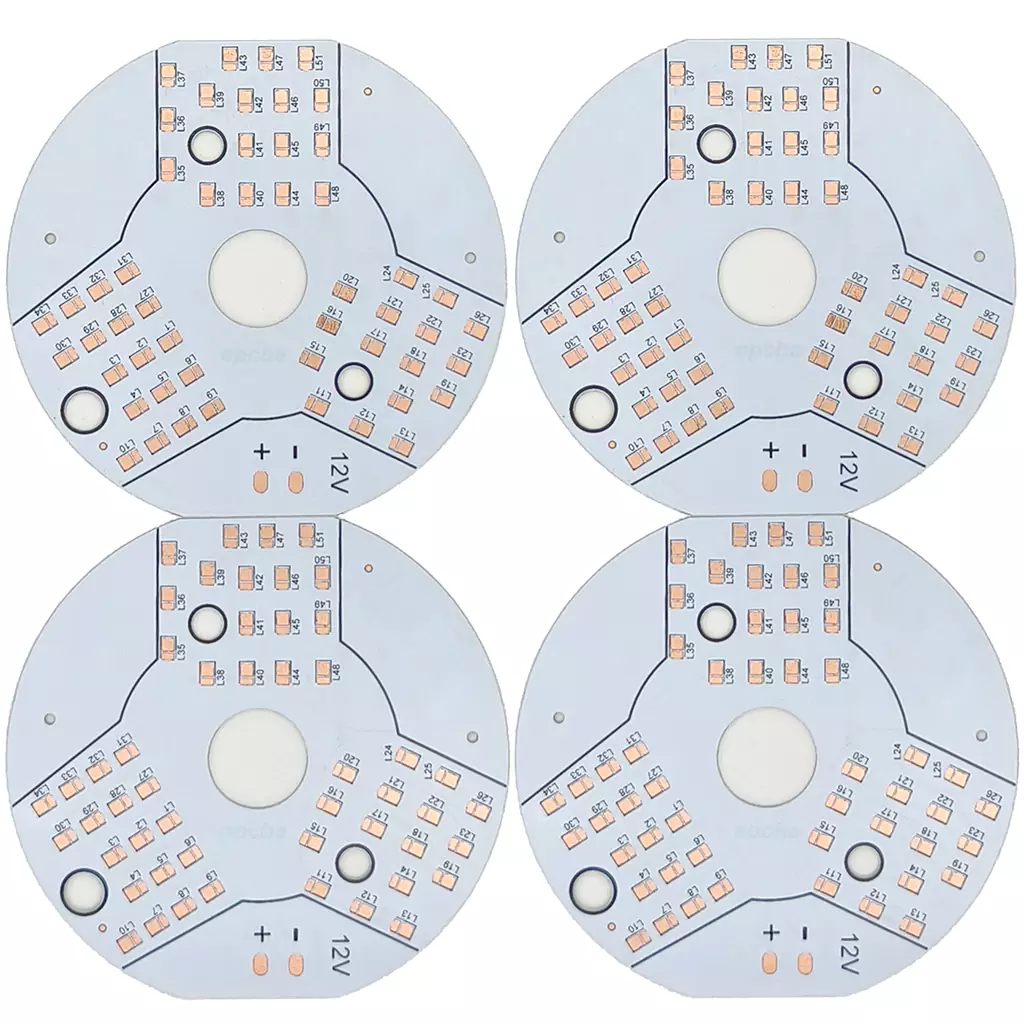
We fabricate aluminum PCB boards specifically for LED applications: light strips, downlights, high-bay fixtures, automotive headlamps, display backlighting, and general consumer LED products. The metal core does the thermal work. The dielectric layer handles the electrical isolation. The copper foil carries the current. Together, they form a substrate that keeps junction temperatures low and light output stable over time.
What You Can Specify
Our standard LED lighting PCB capability covers single-sided through to 4-layer aluminum-core designs. Here’s the range:
-
Board thickness: 0.2 mm to 6.0 mm. The thin end suits flexible or low-profile strip lighting; the thick end supports high-power COB arrays and fixtures with mechanical mounting requirements.
-
Layer count: 1 to 4 layers. Single-layer is the workhorse for most strip and panel applications. Multi-layer aluminum boards support more complex routing and mixed-signal designs without losing the thermal path to the metal core.
-
Copper weight: 1 oz to 4 oz. For constant-current LED strings running at 1A or more, the heavier copper keeps voltage drop and trace heating under control.
-
Minimum trace/space: 3 mil. Fine enough for dense LED arrays and compact driver layouts.
-
Solder mask color: White, black, green, blue. White is the default for LED PCB board applications — it reflects stray light back toward the lens and improves overall fixture efficiency. Black is chosen when the board is visible through a transparent housing and needs to disappear.
-
Silk screen color: White or black, selected for contrast against the chosen solder mask.
-
Surface finish: OSP, HASL (lead-free), immersion silver, or immersion gold (ENIG). For aluminum boards, ENIG and immersion silver are common choices — they provide a flat pad surface for SMT and hold up well through reflow. OSP is an option when cost is the primary driver and shelf life is manageable.
Thermal Design Matters Before You Route
The dielectric layer between the copper foil and the aluminum base is the thermal bottleneck. Its thickness and thermal conductivity determine how efficiently heat moves from the LED pad to the metal core. A thinner dielectric with higher thermal conductivity transfers heat faster but costs more and places tighter limits on the working voltage. We can adjust this layer to match your application: standard thermal conductivity for cost-sensitive products, or higher-performance dielectrics when you’re pushing the lumen density.
If your design includes multiple LEDs in series or parallel, pay attention to copper balancing across the board. Uneven copper distribution on the outer layers can cause the aluminum board to bow during reflow. This is especially noticeable on long, narrow strips. We can add copper thieving to balance the pattern and keep the board flat.
Applications
Our LED PCB board products go into a wide range of end uses: flexible and rigid LED light strips, ceiling panels and troffer retrofits, automotive signal and headlamp modules, COB and CSP LED mounting substrates, display backlight units, and consumer electronics with integrated LED indicators. If your product emits light, there’s likely an aluminum PCB under the diode. Browse our customizable manufacturing options on our official product page: Aluminum PCB
Ordering
This is a custom product. Every LED lighting PCB we build is different — your LED pitch, current requirements, mechanical outline, and thermal budget define the stackup, not the other way around.
To get a quotation, send your Gerber file to sales@opcba.com. Include your preferred solder mask and surface finish, any special dielectric requirements, and your target quantity. We’ll return a formal quote with a lead time as soon as the engineering review is complete.