Medical Equipment is the cornerstone of modern healthcare, powering life-saving interventions, accurate diagnostics, and continuous patient monitoring. From portable blood pressure monitors to complex surgical robots and MRI scanners, these devices rely on stable, high-precision electronic components to ensure safety and efficacy. As a professional one-stop electronic manufacturing service provider, we engineer ISO 13485-compliant PCB/PCBA solutions exclusively for medical devices, addressing the unique clinical and regulatory challenges of healthcare environments—where even the smallest electronic defect can directly impact patient outcomes. Our circuit board solutions are tailored to the stringent demands of these systems, balancing precision, durability, and global regulatory compliance.
The global market for these devices is driven by technological innovation and the growing demand for accessible, high-quality healthcare. Modern clinical equipment trends toward miniaturization (wearable/implantable devices), high-frequency data processing (CT/MRI), and 24/7 clinical operation—all of which depend on PCB/PCBA that meets the highest medical standards. Unlike industrial or consumer electronics, clinical equipment faces unique stressors: frequent high-temperature sterilization, electromagnetic interference in operating rooms, direct contact with bodily fluids, and non-negotiable regulatory compliance. This article explores how our device-specific PCB/PCBA solutions optimize performance, ensure adherence to global medical standards, and support the advancement of smart healthcare technology.
1. Regulatory-Compliant PCB/PCBA Design for Medical Equipment
Compliance is the foundational requirement for medical device PCB/PCBA—all design and manufacturing decisions must align with ISO 13485, IEC 60601-1, and FDA 21 CFR Part 820 standards. Our design team specializes in medical electronic applications, integrating compliance, precision, and clinical durability into every PCB design for these devices, with targeted optimizations for the unique operating conditions of healthcare environments.
1.1 High-Precision Circuit Design for Clinical Accuracy
These devices demand millimetric and microvolt-level precision—especially for diagnostic and surgical systems. We implement design optimizations that eliminate signal drift and ensure stable performance for life-saving clinical equipment:
- Strict impedance matching (±5Ω tolerance) for high-frequency devices (MRI/CT scanners), minimizing signal attenuation during large-volume image data transmission and ensuring clear, accurate diagnostic results.
- Signal isolation between high-power and low-power circuits to prevent EMI interference in sensitive monitoring devices (ECG/pulse oximeters), avoiding misdiagnosis caused by electronic noise.
- HDI (High-Density Interconnect) board design with laser-drilled microvias (ø0.75mm) for portable and implantable clinical equipment, enabling ultra-dense wiring to reduce device footprint without compromising performance.
1.2 Sterilization & Biocompatibility Design Optimization
Most clinical devices undergo frequent sterilization or direct patient contact—our PCB designs are engineered to withstand these harsh conditions without degradation:
- Thermal vias and reinforced copper pours to resist 134℃ steam sterilization (≥500 cycles) for surgical clinical equipment, preventing substrate delamination and solder joint cracking.
- Biocompatible material integration for implantable and patient-contact devices, including PI substrate coatings and non-toxic solder masks, to avoid harmful substance release and comply with ISO 10993 biocompatibility standards.
- Sealed circuit routing for portable devices (ambulance monitors), protecting internal PCB components from moisture, dust, and bodily fluid contamination in emergency clinical settings.
1.3 Compliance-Traceable Design Documentation
To meet FDA and EU medical device regulations, all PCB designs for Medical Equipment include full traceability features:
- Detailed design logs linking every circuit layout to device performance requirements and regulatory standards.
- Version control for all design iterations, supporting regulatory audits and post-market product updates for clinical equipment.
- Design validation reports that confirm alignment with IEC 60601-1 electrical safety standards for all device types.
2. Medical-Grade PCBA Manufacturing & Material Selection
These devices require zero-defect PCBA manufacturing—a single faulty solder joint or low-quality component can lead to life-threatening clinical failures. Our manufacturing processes are ISO 13485-certified, with specialized material selection and strict quality control at every step, ensuring PCB/PCBA for clinical equipment meets the highest medical-grade standards.
2.1 Specialized Material Sourcing for Medical Environments
We select materials exclusively for the unique stressors of clinical equipment, balancing thermal stability, biocompatibility, and long-term durability:
- PCB Substrates: High-Tg FR-4 (Tg ≥170℃) for general medical devices, withstanding repeated sterilization cycles; Rogers 4350B/PTFE for high-frequency diagnostic equipment (CT/MRI), offering low dielectric loss (0.0037 @10GHz) for clear signal transmission; biocompatible PI substrates with titanium nitride coatings for implantable devices (pacemakers), resisting corrosion from bodily fluids.
- Protective Coatings: Medical-grade conformal coating (acrylate/silicone) for all PCBA, protecting against moisture, dust, and bodily fluids while maintaining electrical insulation for clinical devices.
- Electronic Components: Industrial-grade components with a wide temperature range (-40℃~85℃) and anti-vibration performance, screened to ISO 13485 standards. Key components (chips, capacitors, resistors) undergo batch sampling inspection to ensure consistency for medical device mass production.
2.2 Zero-Defect SMT Assembly for Medical Precision
Medical device PCBA features ultra-small components and fine-pitch packages—our assembly processes deliver the precision required for clinical use:
- High-precision SMT mounters with ±30μm placement accuracy, enabling reliable mounting of 01005 ultra-small components and 0.2mm pitch BGA packages for miniaturized clinical equipment.
- Closed-loop temperature control reflow soldering with customized temperature curves for different component types, eliminating cold solder, tin beads, and other defects that compromise device performance.
- Automated optical inspection (AOI) and X-ray testing for 100% of PCBA, detecting sub-millimeter solder joint defects that are invisible to the naked eye—critical for life-saving clinical equipment.
2.3 EMI/EMC Anti-Interference Processing for Clinical Settings
Operating rooms and ICUs are filled with electromagnetic noise from other medical devices—our PCBA processing ensures stable performance in high-interference clinical environments:
- EMI shielding covers on key functional modules of clinical equipment PCBA, suppressing internal electromagnetic radiation and blocking external interference.
- Optimized welding positions for filter capacitors and inductors, reducing signal distortion in sensitive monitoring and diagnostic devices.
- Ground plane design optimization to improve signal integrity, ensuring accurate data transmission for high-frequency clinical equipment.
3. Clinical Application Customization for Medical Equipment
These devices span diverse clinical use cases—each with unique electronic requirements. We provide device-specific PCB/PCBA customization for all major clinical equipment categories, tailoring our solutions to the specific clinical needs of each device type while maintaining global regulatory compliance.
3.1 Diagnostic Medical Equipment PCB/PCBA
Diagnostic devices (CT/MRI scanners, ultrasound machines, blood analyzers) require high-frequency signal transmission and low signal attenuation. Our solutions feature:
- Low-dielectric-loss high-frequency substrates for clear image and data transmission;
- High-precision impedance matching to eliminate signal drift;
- Compact HDI design to reduce the footprint of portable diagnostic clinical equipment.
3.2 Patient Monitoring Medical Equipment PCB/PCBA
Monitoring devices (ECG machines, pulse oximeters, ICU monitors) demand 24/7 stable operation and low power consumption. Our solutions feature:
- Low-power circuit design to extend battery life for portable monitoring devices;
- EMI/EMC anti-interference processing to ensure accurate vital sign data transmission;
- Conformal coating to protect against moisture and dust in ward and emergency settings.
3.3 Surgical & Therapeutic Medical Equipment PCB/PCBA
Surgical devices (surgical robots, laser therapy equipment) and therapeutic devices (ventilators, dialysis machines) require sterilization resistance and high precision. Our solutions feature:
- High-Tg substrates and reinforced solder joints to withstand frequent 134℃ steam sterilization;
- Millimetric-precision circuit design for surgical robot clinical equipment;
- Overcurrent and overheating protection to ensure clinical safety.
3.4 Implantable & Wearable Medical Equipment PCB/PCBA
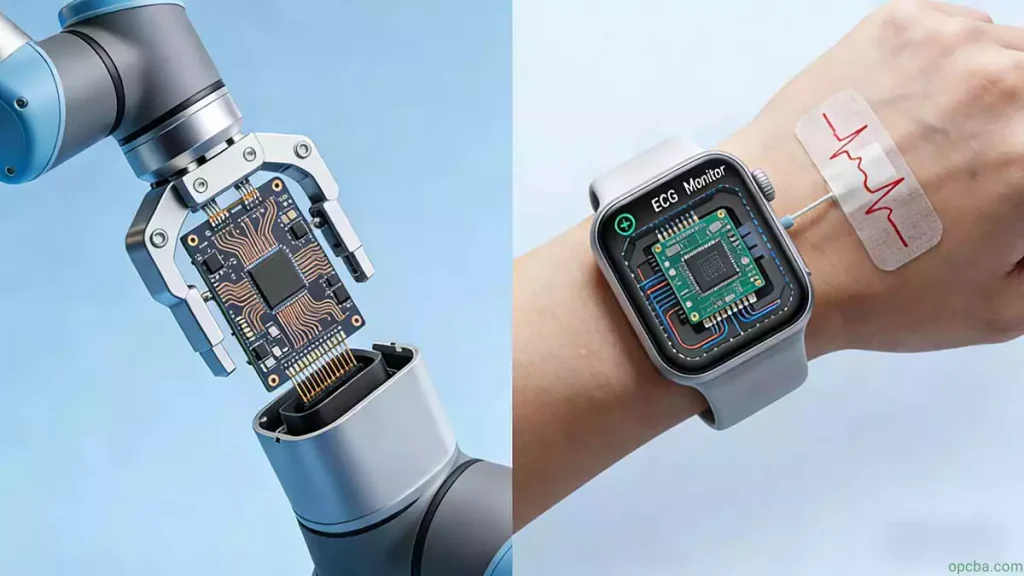
Implantable (pacemakers, neurostimulators) and wearable (smart glucose monitors, fitness trackers) devices demand miniaturization, biocompatibility, and long-term durability. Our solutions feature:
- Biocompatible PI substrates and non-toxic materials for implantable clinical equipment;
- Ultra-thin HDI board design (0.4mm thickness) for wearable devices;
- Corrosion-resistant coatings to withstand long-term contact with skin/bodily fluids.
4. Rigorous Compliance & Reliability Testing for Medical Equipment PCB/PCBA
To ensure PCB/PCBA meets the non-negotiable requirements of clinical equipment, we conduct a comprehensive set of regulatory and reliability tests—simulating real-world clinical conditions and validating compliance with all global medical standards. Only products that pass 100% of tests are delivered to device manufacturers.
4.1 Regulatory Compliance Testing
All PCB/PCBA undergo testing to meet global medical device standards:
- ISO 13485 quality management system compliance validation;
- IEC 60601-1 electrical safety testing for clinical equipment;
- FDA 21 CFR Part 820 traceability audit and documentation review;
- IPC-A-610 Class 3 electronic assembly standard inspection.
4.2 Clinical Environment Reliability Testing
We simulate the harsh operating conditions of clinical equipment in clinical settings:
- Steam sterilization testing (134℃, 500 cycles) for surgical devices;
- High humidity/heat testing (85℃/85%RH, 500h) to prevent moisture-related failures;
- Biocompatibility testing (ISO 10993) for patient-contact and implantable clinical equipment;
- Ionic contamination testing (≤1.56μg/cm² NaCl equivalent) to meet medical-grade cleanliness standards.
4.3 Long-Term Performance & Precision Testing
To validate 24/7 operation capability for life-saving clinical equipment:
- 1000h continuous power-on testing with real-time parameter monitoring (voltage/current/signal transmission);
- High-frequency signal transmission stability testing for diagnostic devices;
- Mechanical vibration testing (10-2000Hz, 10g acceleration) for portable and ambulance clinical equipment.
5. Innovative PCB/PCBA Technology for the Future of Medical Equipment
As smart healthcare and personalized medicine evolve, these devices are becoming more connected, intelligent, and miniaturized. We are committed to innovating our PCB/PCBA technology to support the next generation of clinical equipment, with a focus on three key areas aligned with healthcare industry trends.
5.1 IoT-Enabled Medical Equipment PCB/PCBA
We develop PCB/PCBA with integrated IoT sensors and wireless communication modules for clinical equipment, enabling real-time remote patient data monitoring and device performance tracking. This supports telehealth services and predictive maintenance for these devices, improving healthcare accessibility and reducing clinical downtime.
5.2 AI-Optimized PCB Design for Medical Equipment
Our R&D team uses artificial intelligence to optimize PCB design for clinical equipment, enhancing signal integrity, thermal management, and miniaturization. AI-driven design reduces development time and costs while improving the performance of high-frequency and miniaturized devices.
5.3 Sustainable Medical-Grade PCB/PCBA Solutions
We are exploring eco-friendly materials and energy-efficient manufacturing processes for clinical equipment PCB/PCBA, including biodegradable substrates and lead-free, low-emission soldering processes. Our sustainable solutions reduce environmental impact while maintaining the strict compliance and reliability requirements of these devices.
6. Our Core Advantages for Medical Equipment PCB/PCBA Manufacturing
Medical device manufacturers require a trusted partner with deep expertise in both electronic manufacturing and medical device regulations. Our PCB/PCBA solutions stand out in the medical electronics industry, making us the ideal manufacturing partner for global clinical equipment brands.
6.1 ISO 13485-Certified Full-Process Compliance
We operate an ISO 13485-certified quality management system, with compliance integrated into every step of PCB/PCBA design, manufacturing, and testing. Our full-process traceability meets FDA 21 CFR Part 820 and EU MDR requirements, supporting clinical equipment manufacturers in global market access.
6.2 Deep Medical Equipment Industry Expertise
Our team has years of experience designing and manufacturing PCB/PCBA for clinical equipment, with a deep understanding of clinical challenges, regulatory requirements, and industry trends. We work closely with device R&D teams to co-develop customized solutions that balance performance, compliance, and cost.
6.3 One-Stop Medical Equipment PCB/PCBA Service
We provide end-to-end solutions for medical device manufacturers, from PCB design optimization and material selection to PCBA assembly, compliance testing, and mass production delivery. This streamlines the supply chain, reduces lead times, and ensures consistent quality for clinical equipment mass production.
6.4 Zero-Defect Manufacturing for Clinical Safety
We implement a “zero-defect” manufacturing philosophy for clinical equipment PCB/PCBA, with 100% automated inspection and rigorous manual verification. Our manufacturing yield rate exceeds 99.8%, ensuring the clinical safety and reliability of life-saving medical devices.
Medical Equipment is the lifeline of modern healthcare, and high-reliability, regulatory-compliant PCB/PCBA is the electronic foundation of every safe, effective medical device. Our customized PCB/PCBA solutions are engineered exclusively for these systems, combining clinical precision, sterilization durability, and global regulatory compliance to support better patient outcomes. Whether you are developing diagnostic, monitoring, surgical, or implantable clinical equipment, we have the expertise, technology, and compliance experience to deliver PCB/PCBA solutions that exceed your expectations and advance the future of healthcare.