RF connectors are electronic components for transmitting high-frequency signals. Their core function is to enable efficient and stable signal transmission in RF circuits while minimizing signal loss and external interference. Their design is based on electromagnetic field theory, utilizing impedance matching (typically 50Ω or 75Ω), shielding structures, and mechanical stability to ensure signal integrity.
RF Connector Technical Principles and Design Considerations
1. Impedance Matching: Ensures that the source and load impedances are consistent (e.g., 50Ω) to reduce reflection loss, commonly used in microwave communication and testing equipment.
2. Material and Structural Optimization: Conductor Materials: Gold-plated copper alloys reduce contact resistance and enhance corrosion resistance (e.g., BNC connectors). Insulators: Silicone rubber or thermosetting plastics are for high-temperature resistance and flame retardancy, suitable for aerospace applications.
3. Environmental Adaptability: Extreme Temperatures: Vacuum connectors support -40°C to 125°C cyclic testing to ensure stability in space and high-temperature environments. Sealing: IP68 protection rating prevents water and dust ingress, suitable for outdoor base stations and automotive applications.
Types of RF Connectors
1. BNC Connector
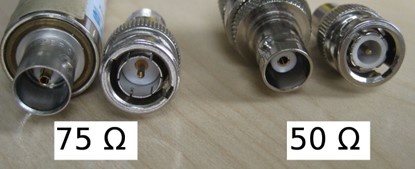
The BNC connector is a quick-connect / disconnect RF coaxial cable connector to maintain the cable’s characteristic impedance at 50 ohms or 75 ohms. BNC (Bayonet Neill-Concelman) connectors are primarily for video, radio, and television frequency connections, typically operating at frequencies up to 2 GHz and voltages up to 500 volts. BNC connectors feature a twist-lock design, with the female connector housing having two contact pins that engage slots in the male connector housing.
Common applications for BNC connectors include analog and serial digital interface video signals, radio antennas, aerospace electronics, nuclear instruments, and test equipment.
2. TNC RF Connectors
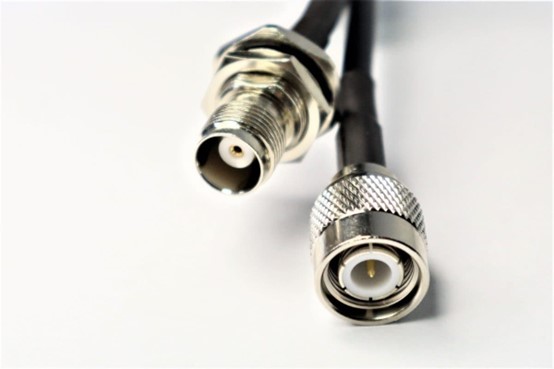
TNC RF connectors are small, threaded, and waterproof coaxial cable connectors with a frequency range up to 11 GHz and an impedance of 50 Ω. They are the threaded version of BNC connectors, using threaded connection nuts to ensure secure mating and offering higher frequency performance than BNC connectors. Their threaded connection interface ensures that the connectors remain securely connected even in high-vibration applications.
TNC connectors are used in a wide range of applications, including antennas, avionics, industrial, wireless communications, defense, and telecommunications sectors.
3. SMA RF Connector
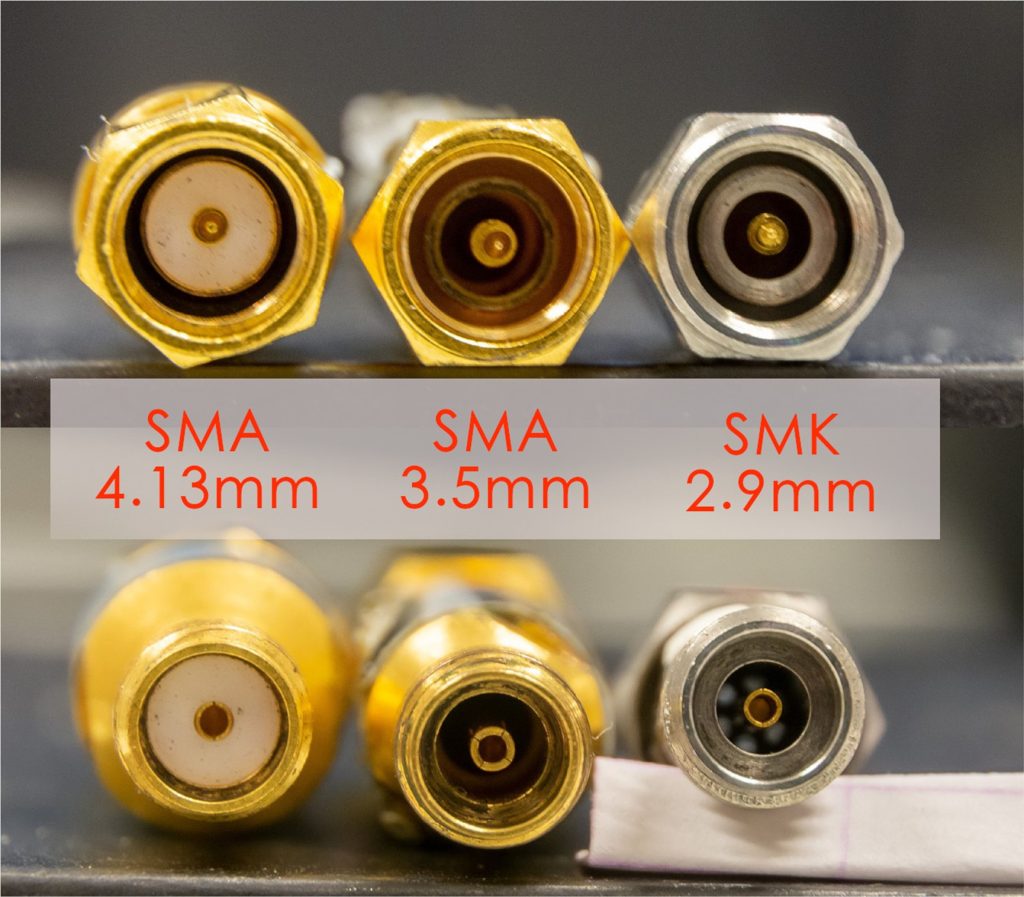
The SMA RF connector is a semi-precision RF connector specifically for coaxial cables with screw-type coupling mechanisms, ensuring uniform contact and significantly reducing reflections and attenuation. The SMA (SubMiniature version A) connector is one of the most common RF connectors, typically employed in telecommunications, wireless communications, and test and measurement applications.
4. SMB RF Connectors
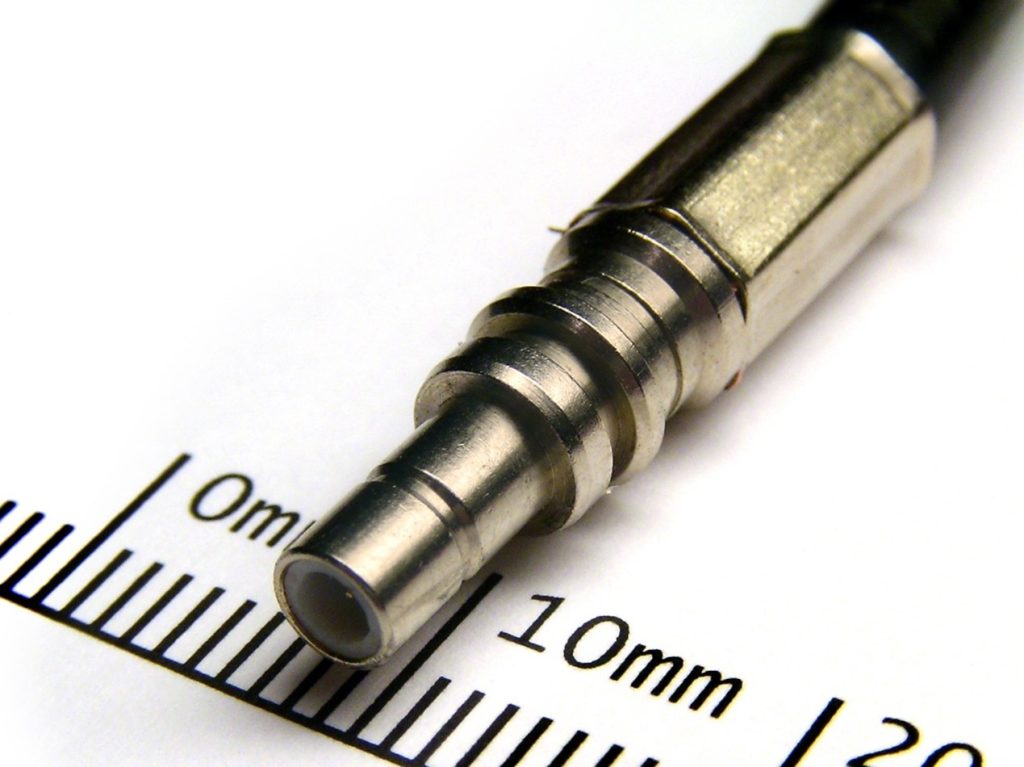
SMB (Subminiature B) connectors are coaxial RF connectors, it developed in the 1960s. They are smaller than SMA connectors. SMB RF Connectors use a snap-on coupling and provide 50 Ω or 75 Ω impedance. They offer excellent electrical performance from DC to 4 GHz. SMB sockets have a male center pin, while SMB plugs have a female latch.
5. SMC RF Connectors
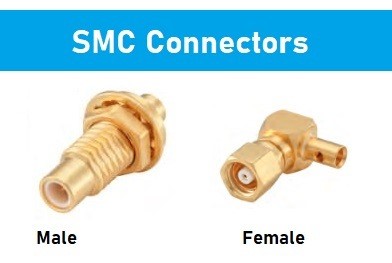
SMC (Super Miniature C-type) connectors are coaxial RF connectors developed in the 1960s. The interface specifications for SMC and many other connectors are referenced in MIL-STD-348. They use a 10-32 UNF threaded interface (screw type). They provide electrical performance from DC to 10 GHz. Male (also known as plug) SMC connectors have a socket for the center contact, while female (also known as jack) SMC connectors have a pin for the center contact.
SMC receptacle connectors have external threads, while SMC connectors have matching hex nuts. They provide characteristic impedances of 50 ohms and 75 ohms, offering interconnect solutions for small coaxial cables (e.g., 50 ohm RG-174, 75 ohm RG-179) and printed circuit boards where compact size is critical.
6. N Series RF Connectors
N connectors (also known as N-type connectors) are medium-sized coaxial RF connectors with threaded and waterproof features, used to connect coaxial cables for transmitting high-frequency signals. Most N connectors can handle frequencies up to 11 GHz, with the latest designs capable of handling frequencies up to 18 GHz. Male connectors are manually secured and have an air gap between the center and outer conductors. Some versions include a hex nut. Coupling uses a 5/8-24 UNEF thread.
People widely use N connectors in radio, television, and data communication fields. They typically use 50-ohm N connectors in infrastructure or wireless data, fixed-line telephony, paging, and cellular systems. They typically use 75-ohm N connectors in cable television system infrastructure.
7. UHF RF Connector
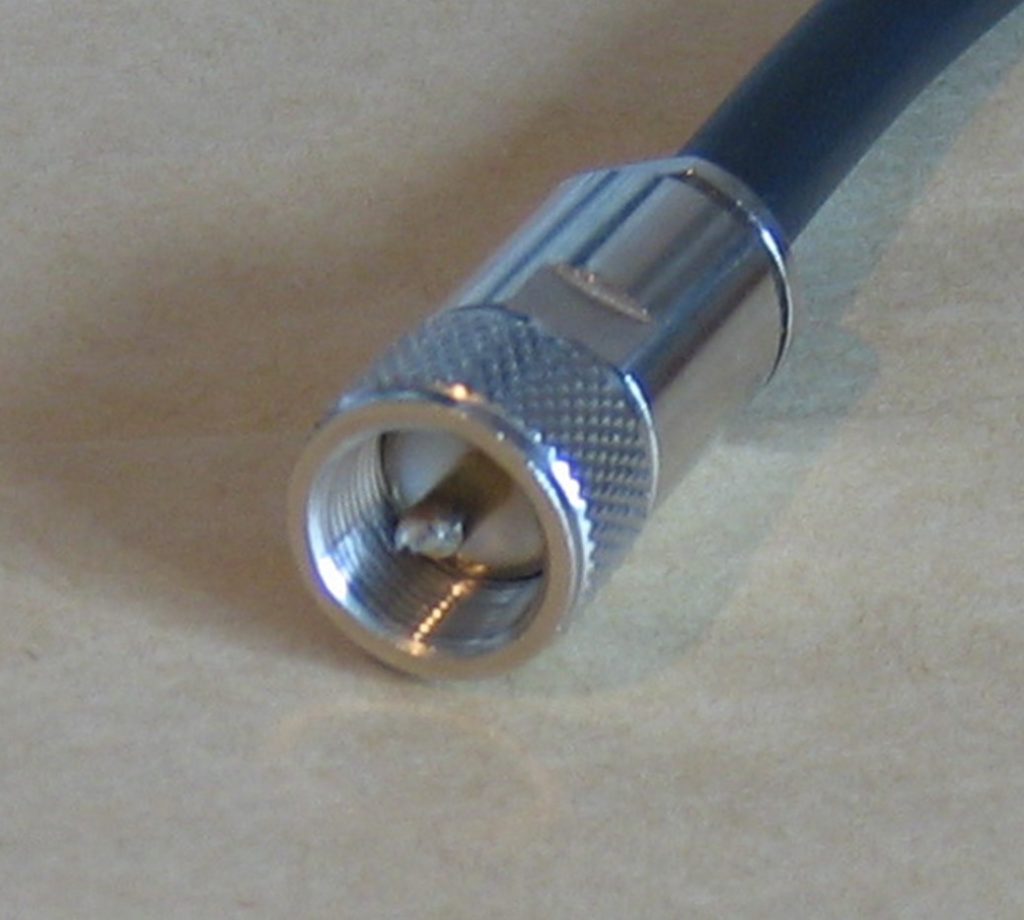
The UHF connector is the name of a threaded RF connector. The connector design was invented in the 1930s for use in the radio industry and is a shielded form of the “banana plug.” It is a widely used standard connector for HF transmission lines on full-size radio equipment, while BNC connectors are mainly used for small handheld devices.
The name “UHF” can be confusing because the connector’s name remained unchanged when the frequency range was renamed. The design was named during an era when ‘UHF’ referred to frequencies exceeding 30 MHz. Today, ultra-high frequency (UHF) refers to frequencies between 300 MHz and 3 GHz, while the previously designated UHF frequency range is now referred to as “VHF.”
Main Applications of RF Connectors
1. High-Frequency Signal Transmission
Used to connect RF signal pathways between antennas, devices, and systems, such as in communication base stations, radar, and satellite applications, ensuring stable signal transmission within the GHz frequency band.
2. Interference Resistance and Shielding
Through metal housings (such as aluminum alloy or gold-plated copper) and insulator designs, they effectively suppress electromagnetic interference (EMI) and signal crosstalk, which is particularly critical in military and aerospace applications.
3. Mechanical Stability Assurance
Using threaded connections and snap-fit structures (such as BNC or SMA interfaces), they ensure reliable physical connections in harsh environments, including those with high vibration and extreme temperatures.
Core Application Areas of RF Connectors
1. Communication Systems
Mobile Communications: 5G base stations and mobile phone antenna connections support multi-band signal transmission (e.g., RFS’s 4.3-10 connectors support LTE and 5G deployments). Satellite Communications: Vacuum RF connectors are used for satellite signal transmission, meeting extreme temperature (1.5K to 920K) and ultra-high vacuum environment requirements.
2. Military and Aerospace
Radar and Navigation: Military radar systems rely on low-loss connectors (e.g., Samtec HDBNC) to transmit precise signals, supporting electronic warfare and guidance requirements.
Space Applications: Must comply with outgassing standards (TML < 1.0%, CVCM < 0.1%) to prevent material volatilization from contaminating sensitive equipment, such as satellite communication systems.
3. Automotive Electronics
In-vehicle Communication and Navigation: Used for GPS and in-vehicle entertainment systems, these connectors must meet waterproof and dustproof (IP68) and vibration-resistant requirements. New Energy Vehicle High-Voltage Systems: High-voltage connectors support high-frequency signal transmission for battery management systems (BMS) and charging interfaces.
4. Medical and Industrial
Medical Imaging: MRI and CT scanners rely on high-precision connectors to transmit microwave signals, ensuring imaging clarity. Industrial Automation: Used in sensor networks and robot control systems, adapting to complex electromagnetic environments.
Trends and Innovation Directions in RF Connectors
1. High-Frequency and 5G Compatibility
Supporting higher frequencies (such as millimeter-wave bands) to meet 5G and 6G communication requirements, e.g., Samtec HDBNC extended to 6GHz performance.
2. Miniaturization and High-Density Integration
Multi-channel connectors (such as high-density BNC) reduce size to accommodate compact devices (e.g., small base stations and wearable devices).
3. Domestic Production Breakthroughs
Domestic companies (such as project teams) have achieved domestic production of high-frequency vacuum RF connectors, breaking foreign monopolies and applying them to scientific research facilities like the Shanghai Synchrotron Radiation Facility.
4. Intelligence and Low Power Consumption
Developing low-power, self-diagnostic intelligent connectors to meet IoT demands and enhance system energy efficiency.
Summary:
RF connectors are core components for high-frequency signal transmission, with their performance directly determining communication quality, device reliability, and system security. From 5G communications to space exploration, from medical imaging to smart vehicles, their application scenarios continue to expand, and technological iteration accelerates continuously. In the future, with the increasing demand for high-frequency, high-density, and domestic production, RF connectors will play a critical role in more fields.