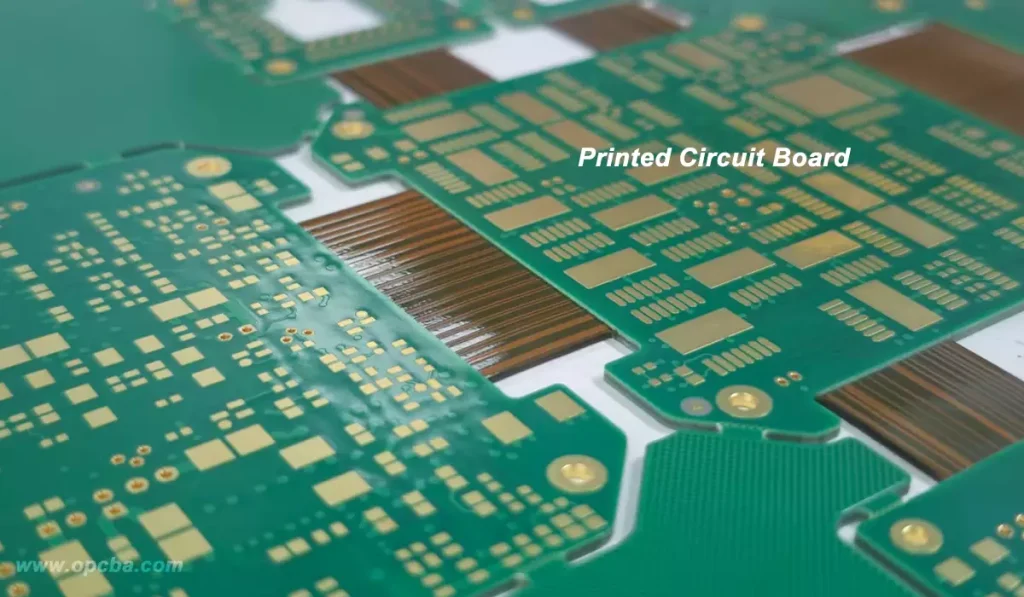
PCB(Printed Circuit Board) is the basic motherboard of almost all electronic products, serving as the core carrier for connecting and integrating electronic components, forming functional modules or finished equipment. The role of PCB in modern electronics cannot be underestimated. Without PCB board, transistors, integrated circuits, resistors, and capacitors would lose stable electrical connections and mechanical support platforms. The uncontrollable factors in electronic manufacturing make strict PCB design and PCB manufacturing the key to ensuring product reliability.
What is a PCB?
PCB is made layer by layer using printing technology, so it is called printed circuit board.
The creator of PCB was Austrian Paul Eisler, who first used circuit board in radios in 1936. The earliest use of circuit board was paper-based copper-clad printed board. Since the emergence of semiconductor transistors in the 1950s, the demand for circuit board has sharply increased. Especially with the rapid development and widespread application of integrated circuits, the volume of electronic devices is becoming smaller and the density and difficulty of circuit wiring are increasing, which requires PCB board to be constantly updated.
At present, the variety of PCB board has evolved from single-sided PCB board to 2-layer PCB, multi-layer PCB, and FPC flexible board. The structure and quality of PCB have also developed to ultra-high density, miniaturization, and high reliability.
Various computer-aided design (CAD) software applications for printed circuit board have been widely used and promoted in the industry. In the specialized PCB manufacturer Opcba, mechanized and automated production has completely replaced manual operations.
The development of AI computing infrastructure and intelligent automotive electronics is related to the PCB industry. According to Prismark data, the global PCB production value increased by 5.8% year-on-year in 2024.
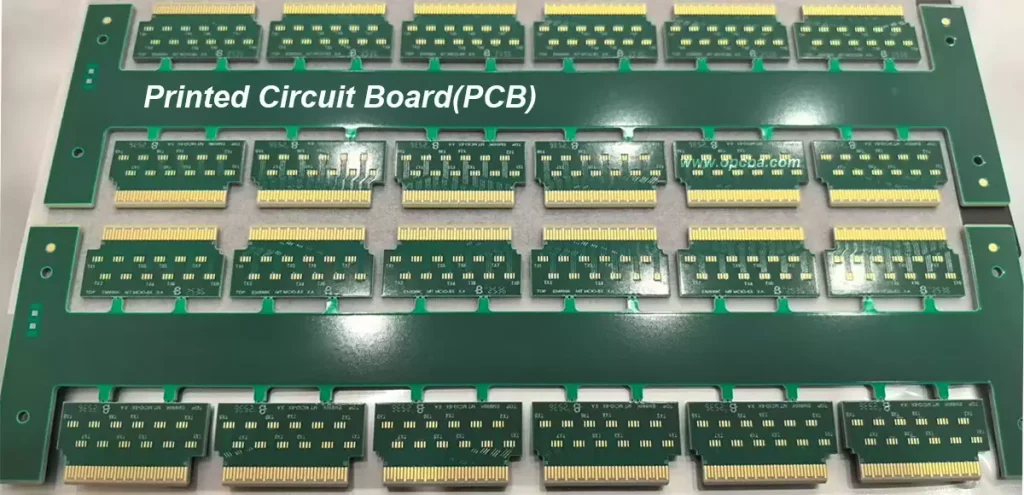
Classification of PCB circuit boards
- 94HB and 94V0 PCB: What is the difference between 94HB vs 94V0? Opcba has stopped producing this type of PCB.
94HB: Ordinary phenolic paper PCB board, not fireproof, using the lowest grade material, die punched, cannot be used as a power board.
94V0: Flame retardant phenolic paper PCB board, with a fire rating of 94V0, can be used for power products. - CEM-1, CEM-3, 22F semi glass fiber board: Single panels have many strict limitations in designing circuits because there is only one layer of circuit, and only early circuits used this type of PCB. Opcba has stopped producing this type of PCB.
- FR4 1-layer PCB: using epoxy glass cloth, with only one layer of circuit, it is a simple circuit board.
- Double sided board: This type of circuit board has wiring on both sides. However, to use wires on both sides, there must be appropriate electrical connections between them. The bridge between these circuits is called a via. A through-hole is a small hole filled or coated with metal on a PCB, which can be connected to wires on both sides. Because the area of double-sided panels is twice as large as single panels, and because the wiring can be staggered, it is more suitable for use in more complex circuits than single panels.
- Multi-layer PCB: In complex application requirements, circuits can be arranged in a multi-layer structure and pressed together, and through-hole circuits can be laid between layers to connect the circuits of each layer.
- Ceramic PCB: With ceramic materials such as alumina and aluminum nitride as the core, it has high thermal conductivity, low thermal expansion coefficient, high temperature resistance, and chemical stability. The manufacturing process mainly includes HTCC, LTCC, DBC, DPC, and AMB.
- High frequency PCB: refers to a printed circuit board specifically designed for transmitting and processing high-frequency signals. The characteristic of high-frequency PCB board is the use of materials with low dielectric constant and low dielectric loss, such as polytetrafluoroethylene/PTFE, ceramic filling materials, etc.
- High speed PCB: It is a circuit board designed for transmitting and processing high-speed digital signals, such as FPG boards.
- High temperature PCB: The TG of conventional FR4 materials is only 130 °C-180 °C. Sometimes, the temperature of PCBA will be higher during operation, and the TG value of high-temperature circuit boards can reach over 250 ° C.
- Metal circuit board: including aluminum PCB and copper PCB, usually used for products that require high temperature heat dissipation, such as aluminum LED PCB.
- FPC: FPC is a circuit board made of polyester film or polyimide as the substrate, which has high reliability and excellent flexibility.
- Rigid-flex PCB: Rigid-flex PCB is a combination of FPC and PCB, and the production of soft hard bonding board should have both FPC production equipment and PCB production equipment.
- HDI PCB: The full name of HDI board is High Density Interconnector, which is a high-density circuit board manufactured using micro blind buried hole technology and stacking process. Its wiring and PAD are very precise, and the phone motherboard uses HDI PCB.
- IC Substrate: In the field of integrated circuits, IC Substrate boards achieve electrical connections between chips and circuit boards through high-density multi-layer printing technology, and provide functions such as heat dissipation and protection.
- Glass substrate PCB: As a new type of substrate material, glass PCB is becoming a key technology direction in advanced semiconductor packaging and high-end display fields due to its excellent thermal management, electrical and mechanical properties.
- Special circuit boards: for example, aluminum is conductive and circuit board, lighter foam circuit board, sapphire circuit board used in aerospace, and Opcba supports customization of circuit boards with various complex processes.
PCB Prototype Service
Opcba is a high-tech enterprise specializing in the research and production of high-precision circuit boards, including multi-layer PCB design, rapid PCB prototyping, and specialty PCB Circuit Board. Opcba has a monthly production capacity of 80000 square meters, providing one-stop PCBA services for prototype, small batch, and large-scale production needs.
Opcba uses advanced manufacturing processes such as double-sided to 108 layer PCB board, high Tg FR-4, Rogers/Taconic high-frequency materials, blind holes, and impedance control. These circuit boards are used in fields such as intelligent electronics, communication equipment, industrial control systems, medical equipment, aerospace technology, power supply, and aerospace.
How long does it take for rapid PCB prototype production? PCB prototype can be completed within 12-72 hours, while mass PCB production typically takes 7-14 days.
PCB manufacturing process capability
This is the standard PCB process capability. If the manufacturing requirements are not within the following range, Opcba supports the development of special circuit board processes for customers.
Layers: Standard PCB board typically have no more than 70 layers, while IC test board require no more than 108 layers to meet. HDI board typically have no more than 20 layers.
Minimum circuit size: FR4 PCB is usually above 3mil, some HDI board are above 2mil, IC substrate are above 25um, and high-frequency board is above 3mil.
Via through holes and blind holes: The mechanical holes of conventional PCB need to be larger than 0.2mm, while HDI laser blind holes are 0.05-0.15mm. The maximum aperture ratio is 12:1 and 48:1 (for IC test board).
Material: FR-4, ceramic, BT material, Polyimide(PI), Copper based, aluminum based, glass, sapphire, PTFE, Carbon hydrogen ceramics, Teflon PCB, etc.
Copper thickness: Conventional PCB use 1oz, high current products use thicker copper, and the thickest etched copper is 12oz.
Types of special PCB processes: Embedded PCB (Embedded copper or components), buried capacitor circuit board, buried resistor circuit board, metal edging, high-frequency material mixed voltage, Extra long&extra, large PCB, Ultra small PCB, etc.