If you work in Printed Circuit Board(PCB) manufacturing or quality control, you’ve almost certainly heard of IPC-6012 and IPC‑A‑600. Plenty of professionals still mix them up, though — and there’s no shame in that. These documents work closely together, but they serve completely different jobs.
IPC stands for the Institute of Interconnect and Packaging Electronics, formerly the Printed Circuit Institute. It develops widely used standards for PCB materials, design, and performance across the industry.
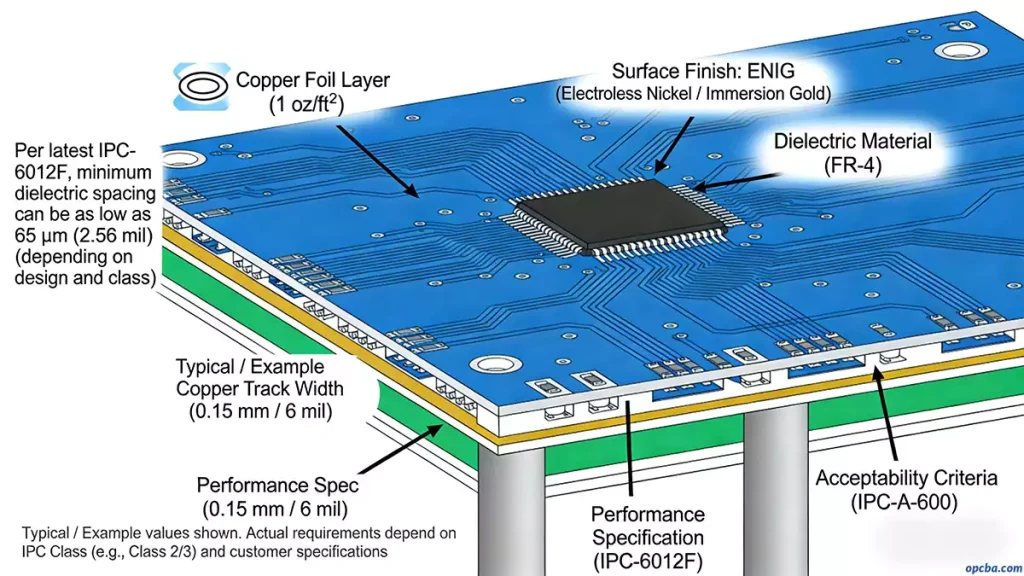
IPC‑6012: The Rules for Building Rigid PCBs
IPC‑6012 is the Quality and Performance Specification for Rigid Printed Circuit Boards.
This isn’t a checklist or a guide for inspectors. It tells manufacturers what a reliable rigid PCB must be, covering the material and process standards that directly shape PCB Assembly (PCBA) quality — from plating thickness to thermal stress and electrical performance.
It covers rigid board types including:
- Single-sided and multilayer boards
- Embedded active/passive circuit boards
- Metal core printed boards
In short, IPC‑6012 sets the internal performance standard.
IPC‑A‑600: The Visual Guide for Acceptance
IPC‑A‑600, often shortened to IPC‑600, is Acceptability of Printed Boards.
This document doesn’t care how you make the board — it cares whether the finished product is acceptable. It uses photos and illustrations to show acceptable and non‑acceptable conditions, both on the surface and in microstructures.
That includes solder mask, silkscreen, hole quality, plating voids, layer alignment, and edge conditions. Customers and suppliers can also agree on custom criteria if they want to go beyond or adjust the standard.
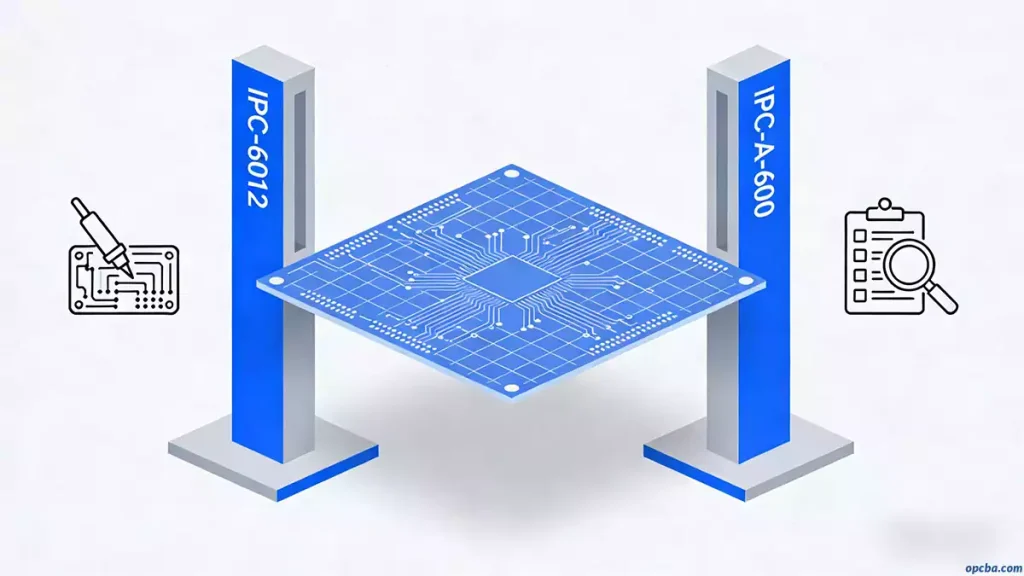
How These Two Standards Actually Work Together
You can think of it like this:
- IPC‑6012 is the invisible threshold — the internal performance a board must hit.
- IPC‑A‑600 is the visible ruler — the visual way to check if that threshold has been met.
Factories build toward IPC‑6012.Inspectors judge using IPC‑A‑600.
One sets the goal. The other shows how to measure it.