Selecting the right PCB material is the foundation of a reliable LED lighting product. LED lights put demands on a board that general electronics do not: they generate concentrated heat, come in form factors from rigid panels to bendable strips, and span price points from budget bulbs to industrial fixtures. This guide breaks down the PCB materials used in LED lighting, the applications each one suits, and the tradeoffs that decide between them.
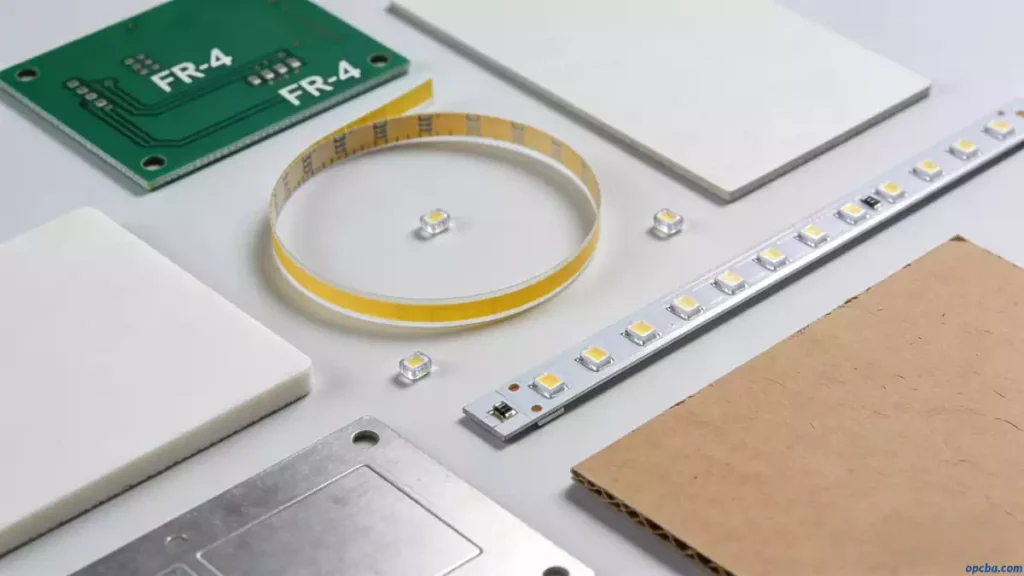
Core PCB Material Categories for LED Lights
Each material handles a different set of LED conditions. The sections below cover the tradeoffs that matter for LED work.
FR-4 (Full Glass Fiber)
FR-4 is the most widely used rigid PCB material for LED lighting, and not every grade performs the same under LED heat. For LEDs, high-Tg FR-4 (Tg ≥ 150°C) is the minimum standard; the low-cost commercial grade is not enough.
- Best for: Low-to-medium power indoor LEDs (bulbs, panel lights, downlights), decorative fixtures with fixed mounting.
- Key LED benefits: Excellent moisture resistance, stable electrical performance, and compatibility with standard SMT assembly.
- Limitations: Poor thermal conductivity (0.3 W/m·K), so it cannot handle high-power LEDs (≥5W) without additional heat sinks.
Flexible PCB (Polyimide)
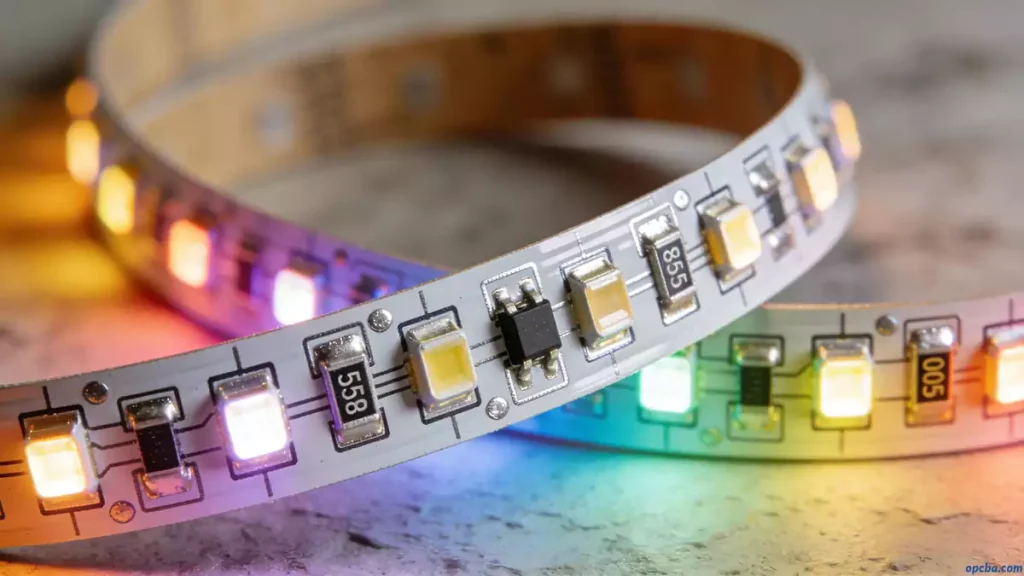
Flex PCBs use polyimide or polyester substrates, making them the only choice for LED applications that require bending or conforming to curved surfaces.
- Best for: LED strip lights, under-cabinet lighting, automotive interior ambient lights, and custom-shaped decorative fixtures.
- Key LED benefits: Ultra-thin profile, can bend up to 180°, and supports dense LED placement for uniform illumination.
- Variants: Rigid-flex PCBs combine flex and rigid sections, which suits LED lights that need both bendable strips and fixed driver mounting areas.
Ceramic PCB
Often confused with aluminum PCBs, ceramic PCBs (alumina or aluminum nitride) are a premium choice for extreme-performance LEDs.
- Best for: High-power LED grow lights, medical surgical lights, and aerospace LED indicators (applications with >20W power or 250°C operating temps).
- Key LED benefits: Superior thermal conductivity (up to 200 W/m·K for aluminum nitride) and zero thermal expansion mismatch with LED chips.
- Limitations: Brittle, costly to fabricate, and overkill for most consumer LEDs.
Paper-Based and Semi-Glass Fiber PCBs
These low-cost materials are rarely recommended for quality LED lighting, but they have niche uses.
- Paper-based PCBs: Only for disposable LED products (e.g., holiday light strings, promotional mini-lights) with short lifespans.
- Semi-glass fiber PCBs: A middle ground for low-power, non-critical LEDs (e.g., basic indicator lights) where cost is the only priority.
- Critical note: Neither resists moisture or aging well, so both fail quickly outdoors or in long-term use.
Aluminum Core PCB
This section covers when to choose an aluminum core board. Our aluminum substrate page covers the full set of benefits.
- Best for: High-power LEDs (≥5W), outdoor floodlights, automotive headlights, and industrial high-bay lights.
- Key differentiator: Balances thermal performance, cost and manufacturability, which makes it more accessible than ceramic for mass production.
PCB Material Recommendations by LED Application
The table below matches common LED products to the material that fits them.
| LED Application | Power Range | Recommended PCB Material | Why? |
|---|---|---|---|
| Indoor LED Bulbs | 1W to 5W | High-Tg FR-4 | Balances cost and reliability; no extreme heat. |
| Bendable LED Strips | 0.5W to 3W per meter | Flexible Polyimide PCB | Conforms to curves; supports dense SMD LED placement. |
| Outdoor Floodlights | 20W to 100W | Aluminum Core PCB | Manages high heat without bulky external heat sinks. |
| Medical Surgical Lights | 15W to 30W | Ceramic PCB (Aluminum Nitride) | Ultra-high thermal conductivity for sterile, long-run operation. |
| Disposable Holiday Lights | <0.5W | Paper-Based PCB | Ultra-low cost for short-term use only. |
| Automotive Headlights | 10W to 20W | Aluminum Core PCB | Withstands vibration and under-hood heat. |
| Custom-Shaped Decorative LEDs | 1W to 5W | Rigid-Flex PCB | Combines bendable LED sections with rigid driver mounts. |
A Five-Step Framework for Choosing a PCB Material
Working through these five steps keeps a project from being over-specified.
Step 1: Define the LED Power Output
- Low power (<5W): FR-4, flexible PCB, or semi-glass fiber (budget only).
- High power (≥5W): Aluminum core PCB (mass production) or ceramic PCB (premium/extreme temps).
Step 2: Confirm the Form Factor Requirement
- Fixed/rigid mounting: FR-4, aluminum core, or ceramic PCB.
- Bendable/curved mounting: Flexible or rigid-flex PCB (no other options).
Step 3: Evaluate the Operating Environment
- Indoor, controlled: FR-4 or flexible PCB.
- Outdoor/harsh (moisture/vibration): High-Tg FR-4, aluminum core, or ceramic PCB.
- Short-term/disposable: Paper-based PCB.
Step 4: Align with Budget Constraints
- Budget: Paper-based → semi-glass fiber → standard FR-4.
- Mid-range: High-Tg FR-4 → flexible PCB → aluminum core PCB.
- Premium: Ceramic PCB (aluminum nitride) → custom rigid-flex PCB.
Step 5: Verify Assembly Compatibility
- Ensure the material supports your LED assembly method (e.g., SMT for surface-mount LEDs, through-hole for legacy components), and optimize component selection with our guide to Capacitor Selection for Switching Power Supply for stable LED driver performance.
- For high-power LEDs, confirm the material works with thermal paste/heat sink integration.
Common Mistakes to Avoid
- Using standard FR-4 for high-power LEDs: Heat builds up in the board and the LEDs burn out early; use high-Tg FR-4 or aluminum core instead.
- Over-specifying ceramic PCBs: Ceramic is unnecessary for most consumer high-power LEDs; aluminum core PCB offers better cost-to-performance.
- Choosing paper-based PCBs for outdoor use: They absorb moisture, leading to short circuits and LED failure within months.
- Ignoring rigid-flex PCBs for hybrid designs: They eliminate the need for separate flex strips and rigid driver boards, reducing assembly costs.
FAQ
Q: Can I use flexible PCB for high-power LED strips?
A: No. Flexible PCBs have poor thermal conductivity, so high-power strips on flex will overheat and fail. For bendable high-power LEDs, pair an aluminum core board with a flexible heat sink.
Q: What is the minimum FR-4 Tg rating for LED lights?
A: 150°C. Standard FR-4 (Tg 130°C) softens under prolonged LED heat, leading to board warping and electrical failure.
Q: When is semi-glass fiber PCB acceptable for LEDs?
A: Only for low-power, indoor indicator LEDs (e.g., on a power switch) where lifespan (≤1 year) and performance are non-critical.
Matching the Material to the Project
Choosing the right PCB material for LED lights comes down to matching the material to your project’s power, form, environment, and budget. If a project sits between two materials, the power range in the table is the usual tie-breaker.
If you’re ready to source custom LED PCBs tailored to your material choice, contact OPCBA today. Our team specializes in matching LED projects with the optimal PCB material and fabrication process, from low-cost FR-4 bulbs to high-performance ceramic medical lights.