Designing for high power? If you’ve ever watched an LED driver cook itself due to heat buildup, you know that FR-4 is the bottleneck. These metal-core boards solve the thermal problem at the board level, turning a common failure point into a reliable design advantage.
What Is an Aluminum Clad PCB?
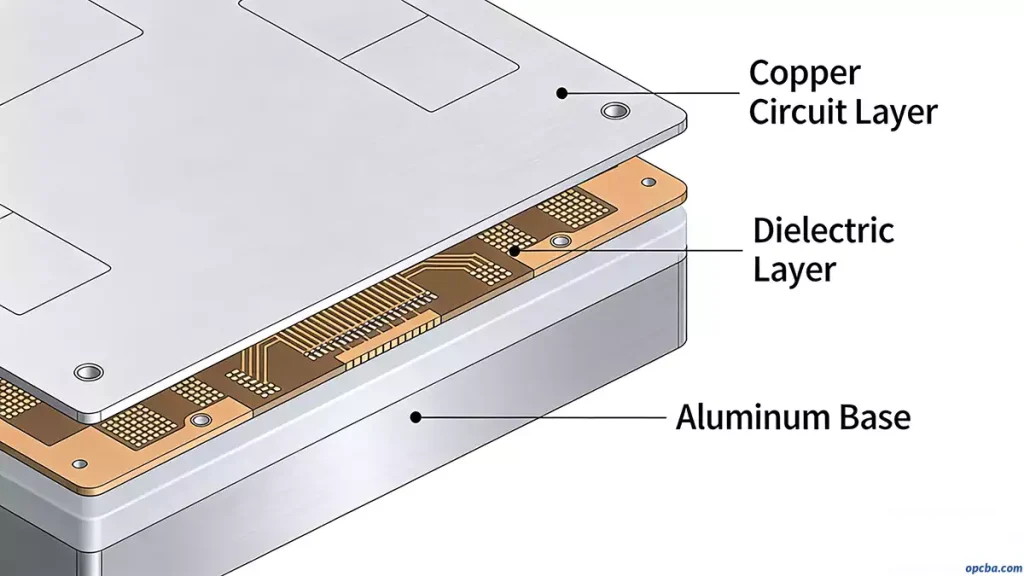
An aluminum clad PCB (or aluminum substrate PCB) is a metal-core printed circuit board built for exceptional heat dissipation. Most single-sided aluminum PCBs feature a three-layer structure: a circuit layer (copper foil), a dielectric insulation layer, and a metal base (usually aluminum). This design is why they outperform FR-4 in heat-heavy applications—especially LED lighting, where the white side solders LED pins, and the aluminum side bonds to a heatsink with thermal paste to pull heat away from components. They’re a specialized form of aluminum PCB, which we cover in depth from structure to applications.
Anatomy of an Aluminum Clad PCB: The Three Layers That Make It Work
The performance of an aluminum PCB hinges on its layered structure. Each layer balances electrical insulation, thermal conductivity, and mechanical strength—no single layer works in isolation.
1. Circuit Layer (Copper Foil)
Electrolytic copper foil forms the circuit layer, etched into conductive traces that connect components. At the same thickness and trace width, it carries far more current than FR-4—a critical detail for high-power designs where current density dictates performance.
2. Insulation Layer (Dielectric)
Peel back the copper, and you’ll find where the real magic happens: the insulation layer. It bridges the gap between electrical isolation and thermal transfer, acting as a bond, insulator, and thermal bridge all at once. Thermal conductivity here directly impacts heat dissipation: a more conductive dielectric cuts down thermal resistance, letting heat from components spread quickly to the aluminum base.
3. Metal Substrate Layer (Aluminum Base)
The aluminum base acts as the PCB’s workhorse heatsink. Choosing the right aluminum alloy depends on thermal conductivity, coefficient of thermal expansion (CTE), mechanical strength, weight, and cost. Three alloy series dominate the industry: 1000, 5000, and 6000—each tailored to specific design needs.
How Aluminum PCBs Dissipate Heat: The Science Behind the Performance
Power components (like LEDs or power transistors) mount directly on the circuit layer. As they operate, heat transfers quickly through the insulation layer to the aluminum base, which then dissipates it to the surrounding environment or a bonded heatsink. The same heat path is laid out in our aluminum substrate thermal dissipation guide. This process sets aluminum PCBs apart from two common alternatives:Compared to FR-4, they cut thermal resistance to a fraction—delivering thermal conductivity 5 to 10 times higher than standard FR-4 (that’s the difference between a warm board and a hand-burning hotspot). Unlike fragile ceramic substrates, they offer robust mechanical durability, standing up to high-stress environments. They also check key boxes for modern manufacturing:
- Compliance with RoHS environmental standards
- Seamless compatibility with SMT assembly processes
- Reduced need for bulky heatsinks and thermal interface materials (TIMs), shrinking product size and cost
Choosing the Right Aluminum Alloy: 1000, 5000, and 6000 Series
The aluminum alloy you select for the base layer directly impacts your PCB’s performance. Let’s break down the three most common series, their strengths, and where they fit best:
1. 1000 Series (Pure Aluminum)
Alloys like 1050, 1060, and 1070 fall into this category—nearly pure aluminum (≥99.0% purity). The last two digits signal minimum purity: 1050 requires ≥99.5% aluminum, 1060 requires ≥99.6%. They’re low-cost and easy to manufacture, perfect for low-power, high-volume applications like consumer LED lighting. Their tradeoff? Lower mechanical strength, which limits use in high-stress environments.
2. 5000 Series (Aluminum-Magnesium Alloys)
Alloys like 5052, 5005, and 5083 blend aluminum with 3–5% magnesium, earning the name “aluminum-magnesium alloy.” They offer low density, high tensile strength, and excellent elongation—popular in aerospace (e.g., aircraft fuel tanks) and industrial applications. The 5052 alloy stands out as the industry standard for aluminum PCBs, striking a balance that works for most high-power designs.
3. 6000 Series (Aluminum-Magnesium-Silicon Alloys)
The 6061 alloy leads this series, mixing magnesium and silicon to combine the best of 4000 and 5000 series alloys. It delivers high strength, excellent corrosion resistance, and easy machinability—ideal for demanding applications like automotive electronics, aerospace components, and camera parts. It costs more than 5052, but the extra durability and thermal stability justify it for critical designs.
For most PCB applications, 5052 (from the 5000 series) hits the sweet spot—balancing texture, hardness, elongation, chemical resistance, and cost without compromising performance.
If you’re tackling a high-power design, we should talk. Whether it’s dialing in the right dielectric thickness or selecting the 6061 alloy for an automotive environment, we’ve helped engineers get those details right. Aluminum is the usual base metal; copper-based and other metal core PCB base materials follow the same three-layer logic. Get an aluminum clad PCB built to your alloy spec.