When designing high-frequency RF circuits, signal loss and electrical consistency make or break performance. These circuits power military radar, satellite communications, and point-to-point digital radio systems. Rogers 5880 PCB was engineered to solve these exact challenges. It is a glass microfiber-reinforced PTFE composite, tailored for the strict demands of precision stripline and microstrip circuit designs.
The secret to its performance lies in its randomly oriented glass reinforcing microfibers. This unique structural choice maximizes fiber reinforcement benefits. These benefits apply to the directions most critical to circuit production and final application performance. Unlike unevenly reinforced materials, this random orientation eliminates directional bias in electrical properties. It ensures your design delivers consistent results across every panel and production run.
Electrical Performance: Uniformity for High-Frequency Reliability
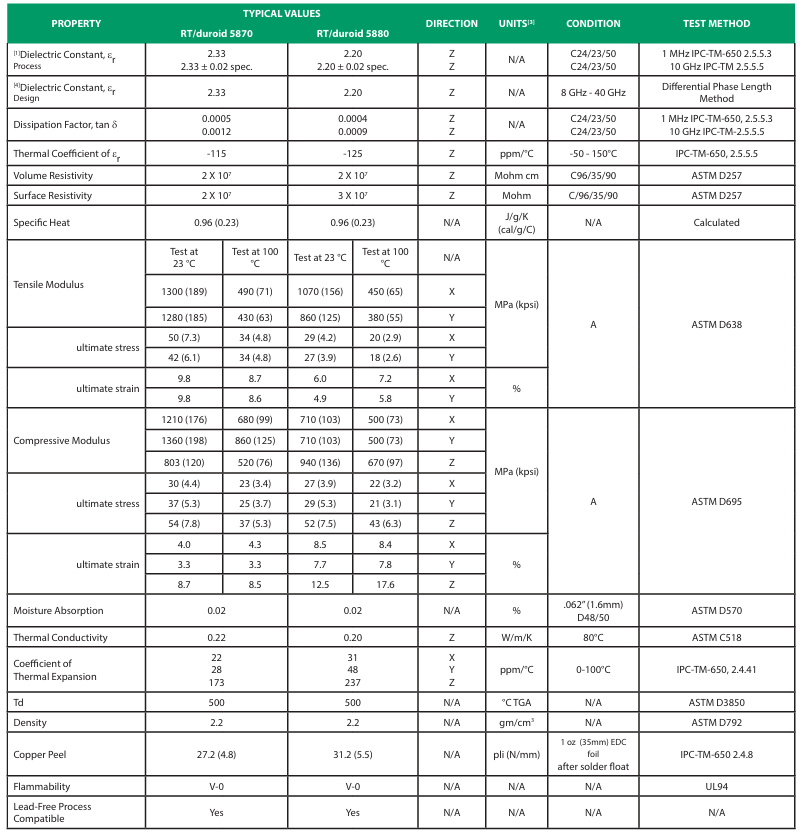
To start with its electrical performance, Rogers 5880 PCB laminates stand out for industry-leading dielectric consistency. Their dielectric constant (Dk) is uniform across every panel. It also remains stable across a wide frequency spectrum. This uniformity is non-negotiable for high-frequency designs. It prevents signal distortion, maintains impedance control, and ensures predictable performance in both lab and operational environments.
Its ultra-low dissipation factor extends its utility to Ku-band and millimeter-wave applications. Even at high frequencies, minimal energy loss keeps signal integrity intact. This is critical for long-range radar, satellite telemetry, and high-data-rate communication systems. In these setups, even tiny attenuation can degrade link performance.
Mechanical & Chemical Durability: Easy Processing for Complex Designs
Beyond electrical performance, Rogers 5880 PCB laminates prioritize practical manufacturing. They machine cleanly. You can cut, shear, and shape them to custom specifications. This process causes no delamination or material degradation. This makes them ideal for complex circuit geometries, common in aerospace and military electronics.
For manufacturing teams, the material also delivers exceptional chemical resistance. It withstands all hot and cold solvents and reagents used in standard PCB processes. These include etching, edge plating, and hole preparation. This compatibility streamlines workflows. It reduces the risk of material failure during production and ensures long-term reliability in harsh operational conditions.
Core Material Advantages & Real-World Value
Each key feature of Rogers 5880 PCB ties directly to tangible benefits for RF design engineers and system integrators:
Lowest Electrical Loss Among Reinforced PTFE
First among these advantages is its unmatched electrical loss performance. This isn’t just a technical spec. It translates to lower signal attenuation over long-haul RF links. It also improves link budgets for millimeter-wave and Ku-band systems. For military radar and satellite communication payloads, this has clear benefits. It means extended mission range and more reliable data transmission.
Low Moisture Absorption
Next, low moisture absorption delivers long-term stability in harsh conditions. Stable moisture resistance keeps electrical properties consistent in humid environments. Your design might operate in tropical outdoor conditions or sealed military enclosures. Either way, performance stays reliable. It eliminates performance drift that plagues lower-quality PTFE composites during long-term deployments.
Isotropic Properties
Third, isotropic properties remove directional performance bias. Isotropic behavior ensures consistent electrical performance in all in-plane directions. For multi-layer stripline and microstrip circuits, this offers key advantages. It eliminates cross-talk and ensures uniform signal propagation. This is critical for complex aerospace systems, where multiple circuits operate at once.
Uniform Electrical Properties Across Frequencies
Fourth, uniform electrical performance across frequencies simplifies design work. Wide-frequency consistency lets Rogers 5880 PCB work seamlessly from X-band to Ka-band and beyond. Designers don’t need to adjust performance parameters for different bands. This simplifies design cycles. It also reduces the risk of costly rework.
Excellent Chemical Resistance
Finally, exceptional chemical resistance supports reliable manufacturing. The material withstands all solvents and reagents used in standard processes. It stays intact during post-processing steps, like edge plating and hole metallization. This cuts production delays. It also ensures consistent quality across finished boards.
Typical Applications for Rogers 5880 PCB
Putting all these benefits together, Rogers 5880 PCB excels in mission-critical high-frequency applications. These include:
- Commercial airline telecommunication systems
- Precision microstrip and stripline RF circuits
- Millimeter-wave sensing and communication platforms
- Military radar and electronic warfare systems
- Guided missile navigation and control circuits
- High-capacity point-to-point digital radio antennas
Partner for Rogers 5880 PCB Manufacturing
For teams ready to leverage Rogers 5880 PCB in their designs, OPCBA offers specialized support. If you’re working on a high-frequency RF project, the OPCBA technical team is ready to assist. These projects often demand the performance of Rogers 5880 PCB. We specialize in manufacturing advanced PTFE composite PCBs. Our expertise covers material selection, design for manufacturability (DFM), and end-to-end production. We serve aerospace, defense, and telecom applications.
Our team can help with key specification choices. These include dielectric thickness, copper foil type (rolled or electrodeposited), and cladding options. We’ll align these with your exact design needs. Contact us at opcba.com/ to discuss your project. You can also get tailored technical guidance for your high-frequency RF design.