If you manufacture or buy PCBs for global markets, you’ve likely encountered one non-negotiable requirement: UL certification. But what exactly is UL, and why does its certification matter so much for circuit boards? This guide explains UL’s role, the key standards for PCBs, what the UL mark means, and why it’s essential for manufacturers and buyers worldwide.
What Is UL (Underwriters Laboratories)?
Underwriters Laboratories (UL) is a leading independent product safety organization. Founded in the U.S. over 120 years ago, it now operates testing facilities worldwide. UL focuses on advancing product safety across all industrial and commercial sectors.
UL’s key services include rigorous product safety testing, manufacturer certification, and the development and continuous update of industry safety standards. For PCB manufacturers and suppliers, UL certification validates that circuit boards meet strict global safety and reliability criteria — a benchmark for quality accepted in markets worldwide, especially the United States.
Key UL Standards for PCB Production
UL has established two core mandatory standards for printed circuit boards, governing their performance, long-term reliability, and fire safety:
1. UL 796
UL 796 is the primary industry standard for printed circuit boards. It outlines comprehensive performance tests that evaluate a PCB’s structural and electrical reliability throughout its service life. This standard sets the baseline for material quality, manufacturing processes, and overall safety compliance.
2. UL 94
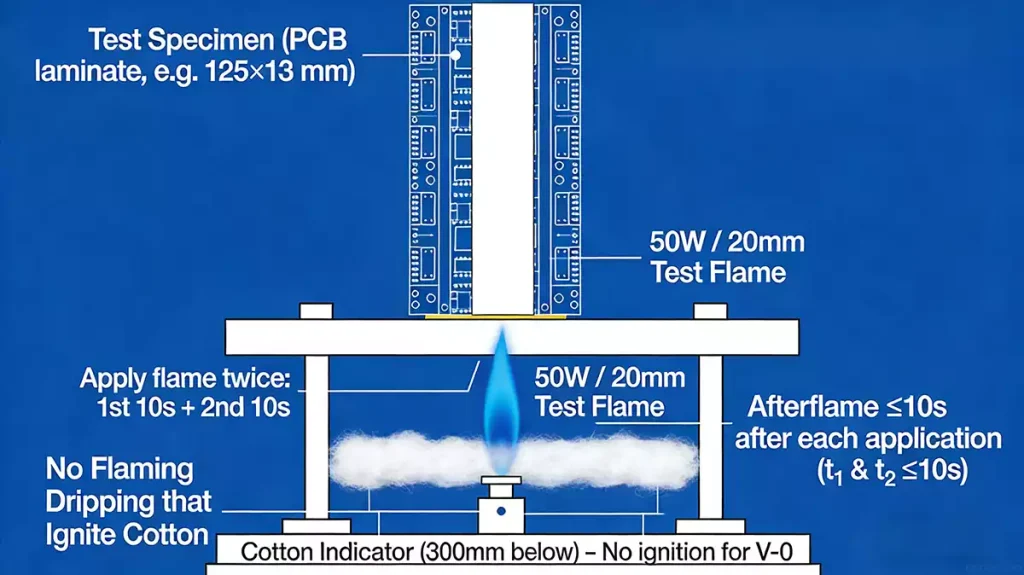
UL 94 is a universal flammability test standard for all plastic materials. For PCB substrates like FR4, this rating is a critical requirement. UL 94 classifies materials by their fire resistance, and UL94 V0 is the minimum mandatory level for PCB substrates.
A UL94 V0 rating means the PCB substrate passes two key tests:
- It self-extinguishes within 10 seconds after the test flame is removed.
- It does not release burning droplets that could ignite nearby materials.
PCBs that meet both UL 796 and UL94 V0 standards are deemed compliant with UL’s core safety requirements for electronic applications.
When Is the UL Mark Required for PCBs?
You need the UL mark on your PCBs whenever fire safety and product safety are top priorities. This is especially true for equipment headed to the U.S. market. If you’re a European or global OEM supplying to the U.S., you’ll almost certainly need UL-certified PCBs.
In addition to regional market requirements, the UL mark may also be specified directly by OEMs or end customers as a non-negotiable quality and safety standard for their PCB procurement.
What Does the UL Mark Mean on a PCB?
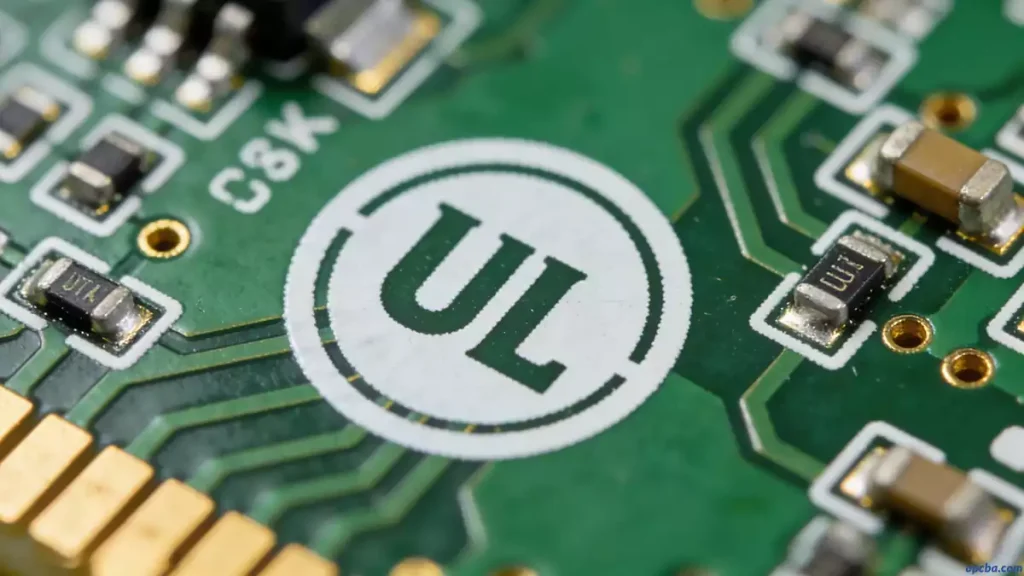
When you see a valid UL mark on a PCB, it signals that the board has passed all UL safety testing. It also means the board meets the strict criteria of relevant standards like UL 796 and UL94 V0. The complete UL marking on a PCB typically includes three key elements:
- The official UL certification logo
- The PCB manufacturer’s certified logo
- The specific PCB type/model designation
At its core, the UL mark verifies that the PCB’s base material meets the UL94 V0 flammability rating — the most critical fire safety standard for electronic circuit boards.
Critical UL Certification Facts for PCBs
- Free to use: If you’re a certified PCB manufacturer, you can display the UL mark at no additional cost.
- Verifiable Certification: Our UL certification (E332411) is publicly verifiable on the official UL Product iQ database, the global authorized hub for all UL certification information checks.
- Global Recognition: While founded in the U.S., UL certification is a globally recognized safety benchmark, adding credibility to PCBs for sales in North America, Europe, and other international markets.
How to Verify UL PCB Certification
Only UL’s official Product iQ database can verify the validity of UL PCB certifications. You can check our certification (E332411) and any other UL PCB certification directly through this database, where you can confirm certification details, access UL safety guide documentation, and validate that a PCB manufacturer’s certification is active and compliant with current industry standards.
Get UL-Certified PCB Details
If you’re looking for UL-certified PCBs and need detailed information about our UL-compliant circuit board options, including substrate types, PCB models, and additional safety certifications, our team is ready to assist. Contact us via phone or email for personalized details on our UL 796 and UL94 V0 certified PCB products.