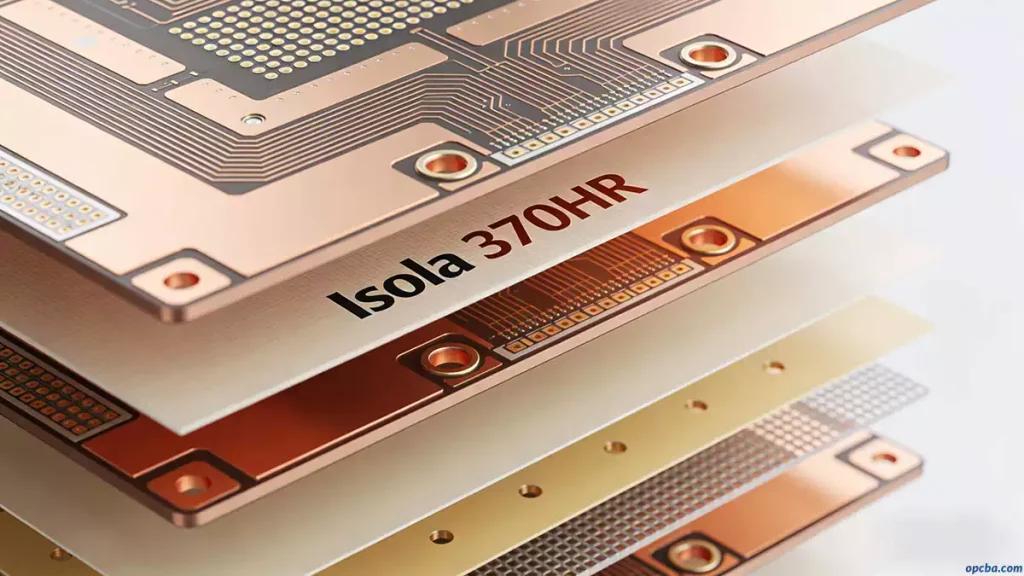
This article is mainly a summary of Rogers RF PCB materials.

Rogers’ RO4000® series of hydrocarbon ceramic laminates and prepregs have consistently led the industry. Rogers PCB material is widely used in microwave and millimeter-wave frequency designs, offering easier circuit fabrication and consistent performance compared to traditional PTFE materials.
Advantages: Compatible with FR-4 manufacturing processes, stable dielectric constant (Dk), high thermal conductivity (0.6 to 0.8 W/m.K), compatible with lead-free soldering processes, low Z-axis CTE, ensuring highly reliable plated vias, optimized cost-effectiveness, Dk range (2.55 to 6.15), and UL 94 V-0 flame retardant rating.
How to Choose a Rogers PCB Material
The model numbers below cover most of the RF work we build, but picking one is not a matter of choosing the highest grade. Five properties decide the answer, and they usually pull against each other.
- Dielectric constant (Dk). Dk sets the trace width that yields a 50 ohm line at a given copper thickness. Lower Dk means wider traces and more board area, which matters at millimeter-wave where line width runs into the limit of the etch process. Higher Dk shrinks the circuit, and that is why RO4360G2 sits at 6.15 for designs that need compact filters and couplers.
- Dissipation factor (Df). Df decides insertion loss, and loss limits how long a microstrip run can be before the stack-up has to change. The spread inside the RO4000 family runs from 0.0020 to 0.0038 at 10 GHz, which is often the difference between a link that closes and one that does not.
- Coefficient of thermal expansion (CTE). Z-axis CTE has to stay close to copper, or the plated through-hole barrels crack after a few hundred thermal cycles. RO4350B sits at 32 ppm/°C and RO4700 stays under 30 ppm/°C, both close enough to copper to survive lead-free reflow and the rework that follows.
- Water absorption. Resin that takes on moisture shifts Dk, and a Dk shift moves the center frequency of a filter or an antenna. Thermoset hydrocarbon systems absorb very little water, so a board that sat in a humid warehouse still tunes the same way on the test bench.
- Cost. Material cost per square meter is only part of it. A laminate that needs special desmear, plasma treatment, or a slower drill recipe costs more than the price list suggests. The RO4000 family processes like FR-4, and that is usually worth more than a small difference in Df.
A workable order for most projects: fix Df from the loss budget first, then check Dk against the board area you can afford, then confirm Z-axis CTE and Tg against the assembly profile. Water absorption and cost break the tie between two Rogers PCB material grades that already pass the first three checks.
RO4350B™ Laminates
Rogers PCB material RO4350B is a proprietary glass cloth reinforced, ceramic/hydrocarbon composite material that combines the electrical properties of PTFE/glass cloth with the processability of epoxy/glass.
The RO4350B laminate features a tightly controlled dielectric constant (Dk) and low loss characteristics, and its processing method is the same as standard epoxy/glass.
Unlike PTFE materials, the RO4350B laminate does not require special through-hole treatment or processing procedures, and its processing cost is significantly lower than traditional microwave laminates. The material meets the UL 94 V-0 flame retardant rating, making it suitable for active devices and high-power RF designs.
Features & Benefits: Dk 3.48 +/- 0.05, Df 0.0037@10GHz, Z-axis thermal expansion coefficient 32 ppm/°C; similar processing technology to FR-4, lower cost, high cost-effectiveness, and excellent dimensional stability.
RO4360G2™ Laminate
Rogers PCB material RO4360G2 laminate is a glass fiber reinforced, ceramic-filled hydrocarbon thermosetting material with extremely low loss characteristics, achieving a good balance between performance and processability.
RO4360G2 laminate is the first high dielectric constant (Dk) thermosetting laminate, with a processing method similar to FR-4. The material can be processed without lead and has increased rigidity, improving the processability of multilayer board structures while reducing material and manufacturing costs. RO4360G2 laminate can be used with RO4400™ series prepregs and the lower dielectric constant RO4000® laminate in multilayer board designs.
Features & Benefits
Dk 6.15 +/- 0.15, Df 0.0038 @ 10GHz, high thermal conductivity up to 0.75 W/(m.K), Z-axis thermal expansion coefficient 28 ppm/°C, high Tg, greater than 280°C TMA; automatable assembly, high-reliability plated through-holes, environmentally friendly, compatible with lead-free processes, efficient supply chain, and short delivery cycle make this material a low-cost, high-efficiency choice.
RO4500™ Laminates
Rogers RO4500 series high-frequency laminates are cost-effective materials designed to meet the needs of the antenna market.
RO4500 high-frequency laminates are fully compatible with conventional FR-4 processing and high-temperature lead-free soldering processes.
These laminates do not require the special treatments required for traditional PTFE materials during the plated through-hole fabrication process.
The RO4500 resin system provides the necessary characteristics for ideal antenna performance. This product line offers affordable alternatives to traditional antenna technologies, helping designers create high-performance antennas at the best cost-effectiveness.
Features & Benefits: Dielectric constant (Dk) range: 3.3 to 3.5 (+/- 0.08), loss factor: 0.0020 to 0.0037, available in large board sizes; LoPro® copper foil provides superior passive intermodulation (PIM) performance, offering better mechanical properties than PTFE materials. CTE matching with copper reduces stress on PCB antennas.
RO4700™ Antenna-Grade Laminates
Rogers’ RO4700 series antenna-grade laminates are highly reliable, high-performance, and low-cost alternatives to traditional PTFE laminates.
The RO4700 resin system provides the necessary characteristics for ideal antenna performance. RO4700 antenna-grade laminates are fully compatible with conventional FR-4 and high-temperature lead-free soldering processes. The material allows for electroplating through-hole fabrication without the special processing required for traditional PTFE laminates.
RO4700 laminate offers high cost-effectiveness and can replace traditional PTFE-based antenna materials, helping designers optimize antenna performance.
Characteristics & Benefits
Dielectric constant: 2.55 / 3.0 (+/- 0.05), Low Z-axis CTE: < 30 ppm/°C, Low TCDk, Loss factor: 0.0022 to 0.0029, High Tg, > 280°C; Low insertion loss,
Dk matches standard PTFE antenna products, excellent passive intermodulation (PIM) performance, and better performance consistency.
RO4830™ Laminate
Rogers RO4830 high-frequency laminate is a thermoset material characterized by high reliability and low cost.
The RO4830 thermoset laminate is ideal for price-sensitive millimeter-wave applications, such as 76-81 GHz automotive radar sensors. The RO4830 laminate can be manufactured using the standard FR-4 process and is typically used in surface-layer millimeter-wave circuit designs for PCB applications of 76-81 GHz automotive radar sensors.
Features & Benefits: Design Dk: 3.24@77GHz, extremely low insertion loss: 2.2dB/inch @77GHz, UL 94 V-0 flame retardant rating, optimized filler, resin, and glass composite system, smooth LoPro® copper foil with reverse processing; significant oxidation resistance, excellent laser drilling performance, stable and consistent dielectric constant, further reducing the overall cost of PCB manufacturing, making it an ideal choice for automotive radar sensor PCB applications.