We refer to printed circuit boards built with an aluminum core as aluminum PCBs, the most widely used substrate solution for modern LED lighting products. First, their unmatched heat dissipation capability makes them the industry standard for LED applications, where thermal management directly impacts product lifespan and performance. This guide breaks down the core structure, key advantages, critical design details, and competitive edge of aluminum substrates for LED lighting PCB, to help you make the optimal material choice for your LED projects.
1. What Is an Aluminum Substrate for LED Lighting PCB?
An aluminum substrate (aluminum core PCB) is a metal-based copper-clad laminate engineered for superior heat dissipation. Specifically, it is purpose-built to solve the thermal challenges of high-power LED lighting systems.
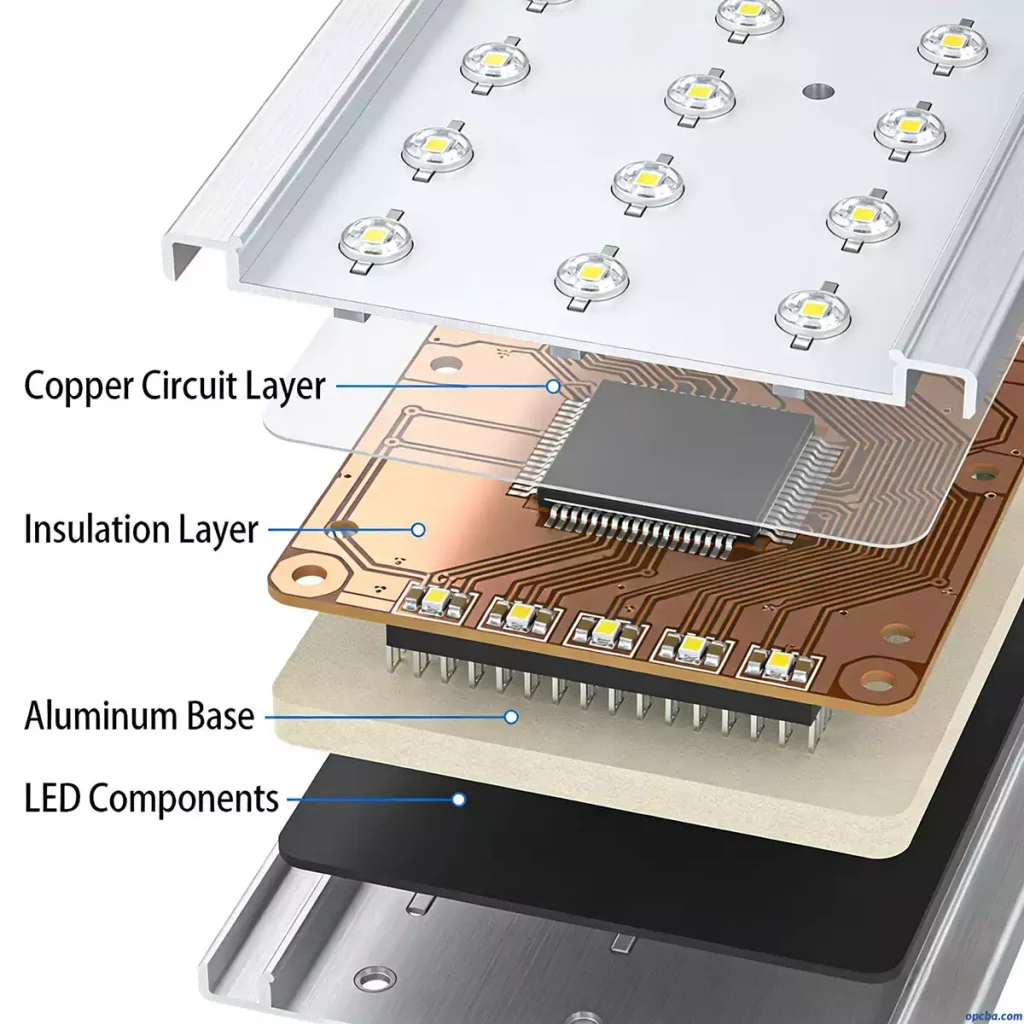
1.1 Core Structure of LED Aluminum PCB
Most LED lighting aluminum PCBs use a single-sided, three-layer structure:
- Circuit Layer (Copper Foil): Etched electrolytic copper foil forms printed circuits, to assemble and connect LED components and other electronic devices.
- Insulation Layer: The core thermal conductive layer, which transfers heat away from components while maintaining electrical insulation between the circuit layer and aluminum base.
- Metal Base Layer: High-purity aluminum alloy substrate, which dissipates accumulated heat into the surrounding environment or heat sink.
Furthermore, we can design aluminum substrates as double-sided boards for high-end LED applications, with a structure of circuit layer, insulation layer, aluminum base, insulation layer, and circuit layer. For very few specialized scenarios, we can also manufacture multilayer aluminum PCBs, which combine standard multilayer circuit structures with insulation layers and an aluminum core.
1.2 Basic Working Principle
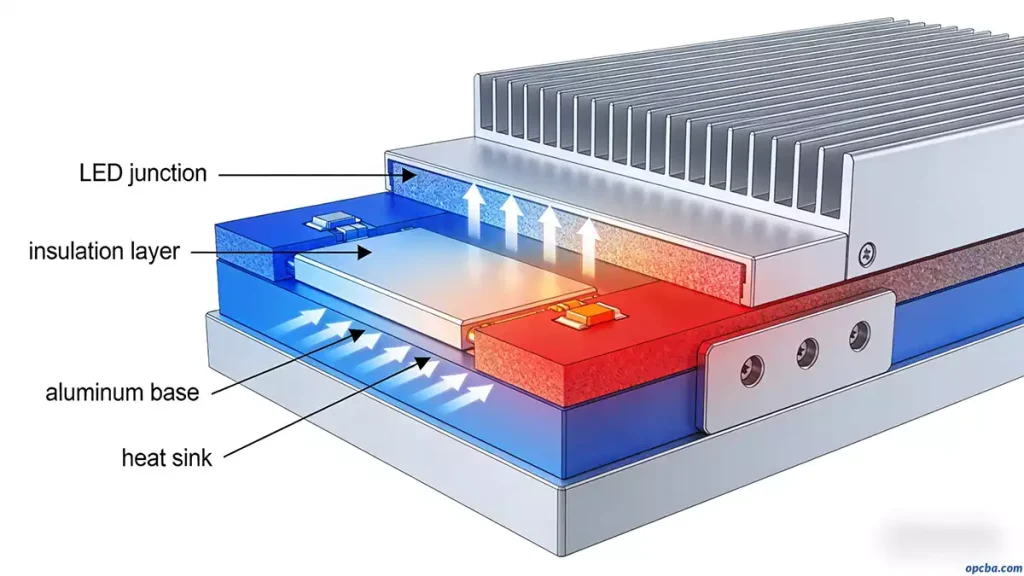
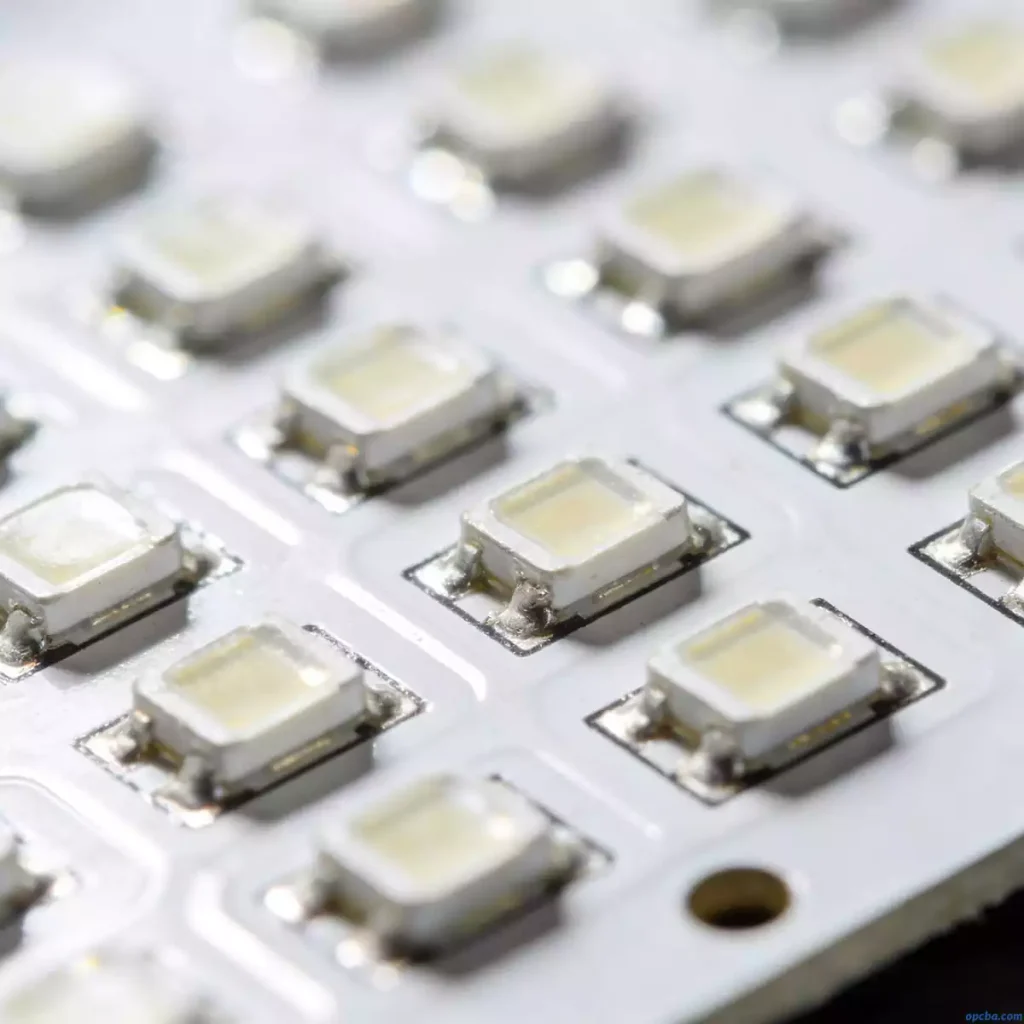
For LED lighting applications, you solder LED pins to the white circuit side of the board. The opposite side exposes the aluminum base, which you typically pair with thermal paste to connect to a heat dissipation component. This structure creates a direct, efficient heat transfer path, pulling heat away from the LED junctions rapidly.
2. Core Advantages of Aluminum Substrates for LED Lighting PCB
Aluminum substrates deliver unique benefits that make them irreplaceable for LED lighting, compared to other substrate materials, including high-performance options like Rogers Laminate. Their key advantages include:
2.1 Unmatched Thermal Management Performance
LEDs generate significant heat during operation, and excessive junction temperature will shorten LED lifespan and reduce light output. In contrast, aluminum substrates reduce thermal resistance to an extremely low level, with excellent thermal conductivity that outperforms standard substrates. This efficient heat transfer keeps LED junctions cool, extends product life, and maintains consistent light output. For the thermal math behind that gap, see our guide to aluminum substrate heat dissipation.
2.2 Higher Current Carrying Capacity
With the same thickness and line width, an aluminum substrate can carry much higher currents than a traditional FR-4 board. This makes it ideal for high-power LED lighting systems, where components need to handle large currents without overheating or performance degradation.
2.3 Superior Mechanical Stability
Aluminum substrates offer outstanding mechanical properties, far exceeding thick-film ceramic circuits and standard FR-4 boards. They resist warping, vibration, and physical impact, which is critical for LED lighting products used in industrial, automotive, and outdoor harsh environments.
2.4 Cost & Size Optimization
Aluminum substrates eliminate the need for bulky heat sinks and additional thermal management hardware. This lets you shrink the overall size of your LED lighting product, cut down on hardware and assembly costs, and simplify your production process. They also fully support surface mount technology (SMT) for high-volume, automated assembly of power components.
3. Aluminum Substrates vs. Traditional FR-4 for LED Lighting
To clearly show the edge of aluminum substrates for LED lighting PCB, the table below compares their core performance with standard FR-4, the most common traditional PCB material:
| Performance Metric | Aluminum Substrate for LED PCB | Standard FR-4 PCB |
|---|---|---|
| Thermal Conductivity | Excellent (1-8 W/m·K, customizable) | Poor (0.3 W/m·K max) |
| Thermal Resistance | Extremely Low | High |
| Current Carrying Capacity | High | Moderate |
| Mechanical Stability | Excellent | Moderate |
| Heat Dissipation Efficiency | Industry Leading | Very Limited |
| Suitability for High-Power LED | Fully Suitable | Not Recommended |
4. Critical Design Details for LED Lighting Aluminum PCB
Beyond thermal performance, specific material and design choices directly impact the final lighting effect and long-term reliability of your LED product.
4.1 White Solder Mask for Optimal Light Output
Nearly all LED lighting aluminum PCBs use a white solder mask, and for good reason. A high-quality white solder mask reflects pure white light from the LEDs, bouncing the light back to the desired direction and maximizing the lighting effect for your end application.
Notably, not all white solder masks perform the same. Low-cost solder masks can fade from bright white to dull, discolored tones during manufacturing and assembly. For example, the electrolysis process of ENIG coating can turn some low-grade white solder masks pink, which tints the final LED light output instead of delivering pure white light. Choosing a high-quality PCB solder mask ensures consistent, high-quality lighting performance for your LED product.
5. FAQ About Aluminum Substrates for LED Lighting PCB
Q: Can aluminum PCB be used for all types of LED lighting?
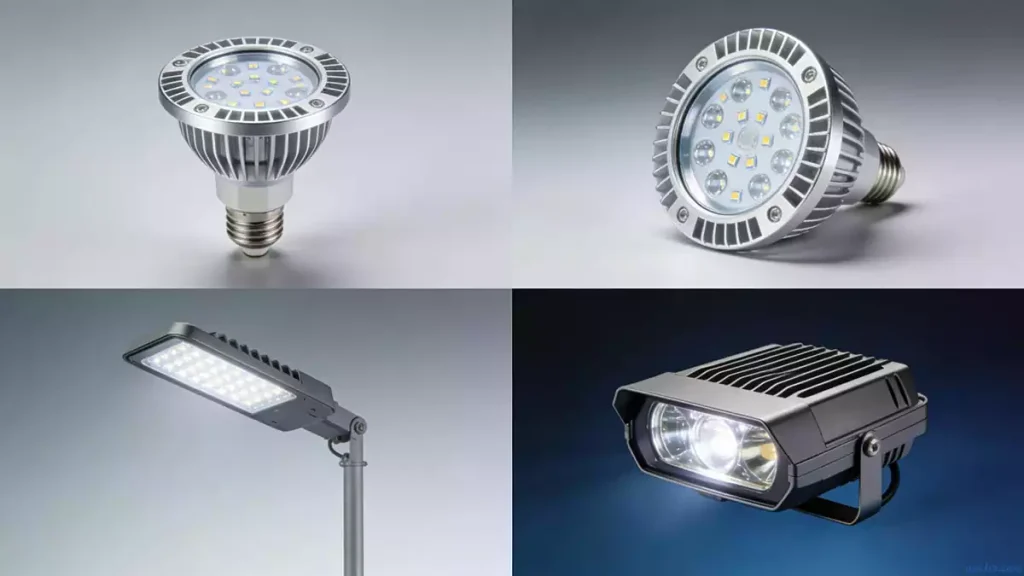
A: Yes. Aluminum substrates work for nearly all LED lighting applications, from low-power household LED bulbs to high-power industrial LED floodlights, automotive LED headlights, and commercial LED lighting systems.
Q: What is the lifespan of an LED aluminum PCB?
A: When paired with high-quality components and proper thermal design, an LED aluminum PCB can support 50,000+ hours of continuous operation, far exceeding the lifespan of LED products built with FR-4 boards.
Q: Is aluminum PCB more expensive than FR-4?
A: The upfront material cost of aluminum PCB is higher than standard FR-4, but it eliminates the need for extra heat dissipation components, reducing total system cost for most LED lighting projects.

6. Final Thoughts
In conclusion, aluminum substrates are the optimal choice for LED lighting PCB, thanks to their unrivaled thermal management, high current carrying capacity, excellent mechanical stability, and long-term cost efficiency. They solve the core thermal challenge of LED lighting systems, extend product lifespan, and deliver consistent, high-quality light output. These advantages make aluminum substrates the most widely used solution in the global LED lighting market.
If you are looking for a reliable supplier for your LED lighting aluminum PCB projects, our team is here to help. For the complete aluminum PCB structure, advantages, and where they’re used across industries, start with our aluminum PCB overview. Ready to specify an LED aluminum board? Request an LED aluminum PCB quote with your stack-up and copper weight.